


Page 78 - FoodFocusThailand No.239 March 2026
P. 78
STRATEGIC R&D


                1. Food Chemistry and Physics form
             the foundation of food product development.
             Understanding the molecular structures
             and chemical  reactions  that  occur  during
             processing, such as caramelization and
             the Maillard reaction, allows researchers
             to precisely control the flavor, texture, and
             product stability. This knowledge is essential
             for effective formulation design.
                2. Biotechnology opens new possibilities
             for food innovation, particularly through the use
             of enzymes and microorganisms to develop
             nutrient-rich plant proteins with nutritional and
             functional properties comparable to those
             of animal-derived proteins. These advance
             have improved sensory quality and consumer
             acceptance of plant-based products.
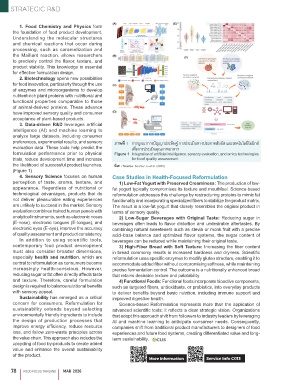
                3. Data-driven R&D  leverages artificial
             intelligence (AI) and machine learning to
             analyze large datasets, including consumer
             preferences, experimental results, and sensory   ภาพที่่� 1   การบููรณาการปััญญาปัระดิิษฐ์์ การปัระเมิินทางปัระสาทสัมิผััส และเทคโนโลยีีโอมิิกส์
             evaluation data. These tools help predict the      เพื่่�อการปัระเมิินคุณภาพื่อาหาร
             formulation performance prior to physical   Figure 1  Integration of artificial intelligence, sensory evaluation, and omics technologies
             trials, reduce development time and increase      for food quality assessment
             the likelihood of successful product launches.   ที่่�มา / Source: Source: Jo et al. (2025)
             (Figure 1)
                4. Sensory Science focuses on human   Case Studies in Health-Focused Reformulation
             perception  of  taste,  aroma,  texture,  and   1) Low-Fat Yogurt with Preserved Creaminess: The production of low-
             appearance.  Regardless  of  nutritional  or   fat yogurt typically compromises its texture and mouthfeel. Science-based
             technological advantages, products that do   reformulation addresses this challenge by restructuring proteins to mimic fat
             not deliver pleasurable eating experiences   functionality and incorporating specialized fibers to stabilize the product matrix.
             are unlikely to succeed in the market. Sensory   The result is a low-fat yogurt that closely resembles the original product in
             evaluation combines trained human panels with   terms of sensory quality.
             analytical instruments, such as electronic noses   2) Low-Sugar Beverages with Original Taste: Reducing sugar in
             (E-nose), electronic tongues (E-tongue), and   beverages often leads to flavor distortion and undesirable aftertastes. By
             electronic eyes (E-eye), improve the accuracy   combining natural sweeteners such as stevia or monk fruit with a precise
             of quality assessment and product consistency.  acid–base balance and optimized flavor systems, the sugar content of
                In addition to using scientific tools,   beverages can be reduced while maintaining their original taste.
             contemporary  food  product  development    3) High-Fiber Bread with Soft Texture: Increasing the fiber content
             must also consider broader dimensions,   in bread commonly results in increased hardness and dryness. Scientific
             especially health and nutrition, which are   reformulation uses specific enzymes to modify gluten structure, enabling it to
             central to reformulation as consumers become   accommodate added fiber without compromising softness, while maintaining
             increasingly health-conscious. However,   precise fermentation control. The outcome is a nutritionally enhanced bread
             reducing sugar or fat often directly affects taste   that retains desirable texture and palatability.
             and  texture. Therefore,  careful  formulation   4) Functional Foods: Functional foods incorporate bioactive components,
             design is required to balance nutritional benefits   such as targeted fibers, antioxidants, or probiotics, into everyday products
             with sensory appeal.                     to deliver benefits beyond basic nutrition, including immune support and
                Sustainability has emerged as a critical   improved digestive health.
             concern for consumers. Reformulation for    Science-based Reformulation represents more than the application of
             sustainability  extends  beyond  selecting   advanced scientific tools; it reflects a clear strategic vision. Organizations
             environmentally friendly ingredients to include   that adopt this approach shift from followers to industry leaders by leveraging
             the  design  of  production  processes  that   AI and machine learning to anticipate consumer needs. Consequently,
             improve energy efficiency, reduce resource   companies shift from traditional product manufacturers to designers of food
             loss, and follow zero-waste principles across   experiences and future food systems, creating differentiated value and long-
             the value chain. This approach also includes the   term sustainability.
             upcycling of food by-products to create added
             value and enhance the overall sustainability
             of the product.
                                                                      More Information        Service Info C013

            78   FOOD FOCUS THAILAND  MAR  2026


                                                                                                                     23/2/2569 BE   08:02
         75-78_Stategic R&D_CMU.indd   78
         75-78_Stategic R&D_CMU.indd   78                                                                            23/2/2569 BE   08:02

