


Page 96 - FoodFocusThailand No.239 March 2026
P. 96
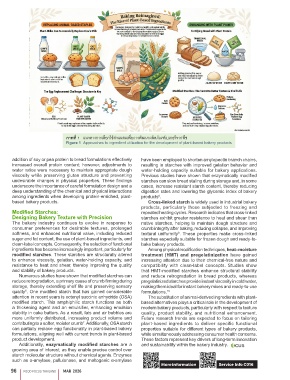
ภาพที่่� 1  แนวทางการเลืือกใช้้ส่่วนผส่มเพื่ื�อการพื่ัฒนาผลืิตภััณฑ์์เบเกอรีจากพื่ืช้
                                   Figure 1  Approaches to ingredient utilization for the development of plant-based bakery products


             addition of soy or pea protein to bread formulations effectively   have been employed to shorten amylopectin branch chains,
             increased overall protein content; however, adjustments to   resulting in starches with improved gelation behavior and
             water ratios were necessary to maintain appropriate dough   water-holding capacity suitable for bakery applications.
             viscosity while preserving gluten structure and preventing   Previous studies have shown that enzymatically modified
             undesirable changes in physical properties. These findings   starches can slow bread staling during storage and, in some
             underscore the importance of careful formulation design and a   cases, increase resistant starch content, thereby reducing
             deep understanding of the chemical and physical interactions   digestion rates and lowering the glycemic index of bakery
             among ingredients when developing protein-enriched, plant-  products .
                                                                          8
             based bakery products.                                  Cross-linked starch is widely used in industrial bakery
                                                                  products, particularly those subjected to freezing and
             Modified Starches:                                   repeated heating cycles. Research indicates that cross-linked
             Designing Bakery Texture with Precision              starches exhibit greater resistance to heat and shear than
             The bakery industry continues to evolve in response to   native starches, helping to maintain dough structure and
             consumer  preferences  for  desirable  textures,  prolonged   crumb integrity after baking, reducing collapse, and improving
             softness, and enhanced nutritional value, including reduced   textural uniformity . These properties make cross-linked
                                                                                  9
             sugar and fat content, the use of plant-based ingredients, and   starches especially suitable for frozen dough and ready-to-
             clean-label concepts. Consequently, the selection of functional   bake bakery products.
             ingredients has become increasingly important, particularly for   Among physical modification techniques, heat–moisture
             modified starches. These starches are structurally altered   treatment  (HMT)  and  pregelatinization  have  gained
             to enhance viscosity, gelation, water-holding capacity, and   increasing attention due to their chemical-free nature and
             resistance to heat and shear, thereby improving the quality   compatibility with clean-label concepts. Studies show
             and stability of bakery products.                    that HMT-modified starches enhance structural stability
               Numerous studies have shown that modified starches can   and reduce retrogradation in bread products, whereas
             reduce retrogradation, a primary cause of crumb firming during   pregelatinized starches provide instant viscosity in cold water,
             storage, thereby extending shelf life and preserving sensory   making them ideal for instant bakery mixes and ready-to-use
             quality . One modified starch that has gained considerable   formulations. 10
                  6
             attention in recent years is octenyl succinic anhydride (OSA)   The substitution of animal-derived ingredients with plant-
             modified starch. This amphiphilic starch functions as both   based alternatives plays a critical role in the development of
             a thickening agent and an emulsifier, enhancing emulsion   modern bakery products, particularly with respect to texture
             stability in cake batters. As a result, fats and air bubbles are   quality,  product  stability,  and  nutritional  enhancement.
             more uniformly distributed, increasing product volume and   Future research trends are expected to focus on tailoring
             contributing to a softer, moister crumb . Additionally, OSA starch   plant-based ingredients to deliver specific functional
                                          7
             can partially replace egg functionality in plant-based bakery   properties suitable for different types of bakery products,
             formulations, aligning well with current trends in plant-based   while simultaneously addressing consumer health concerns.
             product development.                                 These factors represent key drivers of long-term innovation
               Additionally, enzymatically  modified  starches are a   and sustainability within the bakery industry.
             growing area of interest, as they enable precise control over
             starch molecular structure without chemical agents. Enzymes
             such as α-amylase, pullulanase, and maltogenic α-amylase
                                                                           More Information        Service Info C016
            96   FOOD FOCUS THAILAND  MAR  2026


                                                                                                                     22/2/2569 BE   19:32
         92-96_��������� 3.indd   96                                                                                 22/2/2569 BE   19:32
         92-96_��������� 3.indd   96

