


Page 40 - FoodFocusThailand No.239 March 2026
P. 40
SPECIAL FOCUS


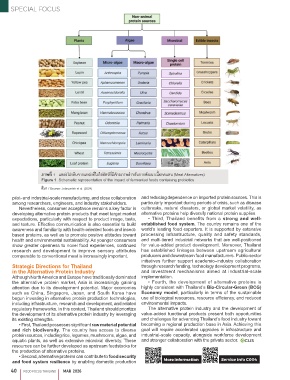
                         ภาพที่่� 1   แหล่่งโปรตีีนจากแหล่่งที่ี�ไม่่ใช่่สััตีว์์ที่ี�ม่ีศัักยภาพสัำาหรับการพัฒนาเน้�อที่ดแที่น (Meat Alternatives)
                         Figure 1  Schematic representation of the impact of fermented foods containing probiotics

                         ที่่�มา / Source: Jafarzadeh et al. (2024)
             pilot- and industrial-scale manufacturing, and close collaboration  and reducing dependence on imported protein sources. This is
             among researchers, engineers, and industry stakeholders.  particularly important during periods of crisis, such as disease
               Nevertheless, consumer acceptance remains a key factor in  outbreaks, natural disasters, or global market volatility, as
             developing alternative protein products that meet target market  alternative proteins help diversify national protein supplies.
             expectations, particularly with respect to product image, taste,   •  Third,  Thailand  benefits  from  a  strong and  well-
             and texture. Effective communication is also essential to build  established food system. The country remains one of the
             awareness and familiarity with health-oriented foods and insect-  world’s leading food exporters. It is supported by extensive
             based proteins, as well as to promote positive attitudes toward  processing infrastructure, quality and safety standards,
             health and environmental sustainability. As younger consumers  and multi-tiered industrial networks that are well-positioned
             show greater openness to novel food experiences, continued  for value-added product development. Moreover, Thailand
             research and development to improve sensory attributes  has  established  linkages  between  upstream  agricultural
             comparable to conventional meat is increasingly important.   producers and downstream food manufacturers. Public-sector
                                                                  initiatives further support academic–industry collaboration
             Strategic Directions for Thailand                    through research funding, technology development programs,
             in the Alternative Protein Industry                  and  investment  mechanisms  aimed  at  industrial-scale
             Although North America and Europe have traditionally dominated  implementation.
             the alternative protein market, Asia is increasingly gaining   • Fourth, the development of alternative proteins is
             attention due to its development potential. Major economies  highly consistent with Thailand’s Bio-Circular-Green (BCG)
             such as China, Singapore, Japan, and South Korea have  Economy model, particularly in terms of the sustainable
             begun investing in alternative protein production technologies,  use of biological resources, resource efficiency, and reduced
             including infrastructure, research and development, and related  environmental impacts.
             regulatory frameworks. In this context, Thailand should prioritize   The alternative protein industry and the development of
             the development of its alternative protein industry by leveraging  value-added functional products present both opportunities
             its existing strengths.                              and challenges for advancing Thailand’s food industry toward
               • First, Thailand possesses significant raw material potential  becoming a regional production base in Asia. Achieving this
             and rich biodiversity. The country has access to diverse  goal will require accelerated upgrades in infrastructure and
             protein sources, including rice, legumes, mushrooms, algae, and  industrial-scale capacity, alongside workforce development
             aquatic plants, as well as extensive microbial diversity. These  and stronger collaboration with the private sector.
             resources can be further developed as upstream feedstocks for
             the production of alternative proteins.
               • Second, alternative proteins can contribute to food security
             and food system resilience by enabling domestic production     More Information        Service Info C004
            40   FOOD FOCUS THAILAND  MAR  2026


                                                                                                                     22/2/2569 BE   19:17
         36-40_Special Focus_�����������.indd   40                                                                   22/2/2569 BE   19:17
         36-40_Special Focus_�����������.indd   40

