


Page 45 - FoodFocusThailand No.239 March 2026
P. 45
SPECIAL FOCUS

                    satisfaction in terms of raw materials. However, increasing   should emphasize health benefits alongside familiar taste,
                    the proportion of plant protein beyond this level may lead   rather than focusing exclusively on sustainability messaging.
                    to the development of a “musty flavor,” which is a key factor   Taste and familiarity are primary drivers of repeat purchase
                    contributing to immediate product rejection.         in the mass market, making them more effective positioning
                       In nutritional dimensions, hybrid meat has the potential   strategies for hybrid meat products.
                    to elevate overall food quality. It can significantly improve the
                    Nutri-Score of processed meat products from levels “D” or “E”   Thailand’s Hybrid Meat Industry:
                    to level “C”. Nutri-Score is a front-of-pack labeling system that   Toward a Sustainable Protein Future
                    classifies food quality from A to E by considering nutrients that   Thailand is accelerating the development of its alternative
                    should be limited, alongside beneficial components such as   protein  industry  under  the  Bio-Circular-Green  Economy
                    fiber, protein, and the proportion of plant-based ingredients.   (BCG) model, with a focus on advancing high-potential local
                    This system helps consumers quickly assess nutritional value   resources such as duckweed and split gill mushrooms into
                    and encourages manufacturers to develop more balanced   strategic protein sources capable of generating economic
                    food formulations.                                   value while strengthening national food security. This direction
                       Blending plant protein at proportions of approximately   reflects a transition from being primarily a raw material
                    30–50% can help reduce saturated fat and total energy intake   producer to becoming a hub for food innovation that utilizes
                    while simultaneously increasing fiber and bioactive compound   biological resources more efficiently. On the regulatory front,
                    content, thereby positively impacting consumer health.   Thai authorities have begun implementing stricter labeling
                    Additionally, recent research indicates that the application of   frameworks during 2024–2025 to prevent consumer confusion,
                    high-frequency sound waves (ultrasound) during processing   emphasizing transparency in product naming and imagery,
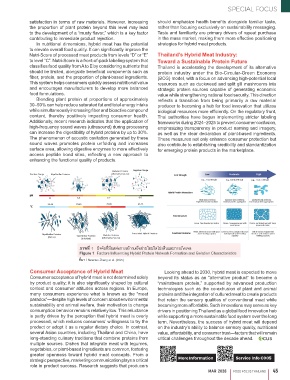
                    can increase the digestibility of hybrid proteins by up to 30%.   as well as the clear declaration of plant-based ingredients.
                    The phenomenon of acoustic cavitation generated by these   These measures not only enhance consumer protection but
                    sound waves promotes protein unfolding and increases   also contribute to establishing credibility and standardization
                    surface area, allowing digestive enzymes to more effectively   for emerging protein products in the marketplace.
                    access peptide bond sites, reflecting a new approach to
                    enhancing the functional quality of products.


                                         ภาพที่่� 1   ปััจจัยที่่�มี่ผลต่่อการสร้างเครือข่่ายไฮบริดโปัรต่่นและการเกิดเจล
                                         Figure 1  Factors Influencing Hybrid Protein Network Formation and Gelation Characteristics
                                        ที่่�มา / Source: Zhang et al. (2025)

                    Consumer Acceptance of Hybrid Meat                      Looking ahead to 2030, hybrid meat is expected to move
                    Consumer acceptance of hybrid meat is not determined solely   beyond its status as an “alternative product” to become a
                    by product quality; it is also significantly shaped by cultural   “mainstream protein,” supported by advanced production
                    context and consumer attitudes across regions. In Europe,   technologies such as the co-extrusion of plant and animal
                    many consumers experience what is known as the “meat   proteins and the integration of cultured meat to create products
                    paradox”—despite high levels of concern about environmental   that retain the sensory qualities of conventional meat while
                    sustainability and animal welfare, their motivation to change   becoming more affordable. Such innovations may serve as key
                    consumption behavior remains relatively low. This reluctance   drivers in positioning Thailand as a global food innovation hub
                    is partly driven by the perception that hybrid meat is overly   while supporting a more sustainable food system over the long
                    processed, which reduces consumers’ willingness to try the   term. Nevertheless, the success of hybrid meat will depend
                    product or adopt it as a regular dietary choice. In contrast,   on the industry’s ability to balance sensory quality, nutritional
                    several Asian countries, including Thailand and China, have   value, affordability, and consumer trust—factors that will remain
                    long-standing culinary traditions that combine proteins from   critical challenges throughout the decade ahead.
                    multiple sources. Dishes that integrate meat with legumes,
                    vegetables, or plant-based ingredients are common, fostering
                    greater openness toward hybrid meat concepts. From a
                    strategic perspective, marketing communication plays a critical   More Information    Service Info C005
                    role in product success. Research suggests that producers
                                                                                              MAR  2026  FOOD FOCUS THAILAND  45


                                                                                                                     22/2/2569 BE   19:18
         42-45_Special Focus_������.indd   45                                                                        22/2/2569 BE   19:18
         42-45_Special Focus_������.indd   45

