


Page 70 - FoodFocusThailand No.241 May 2026
P. 70
STORAGE, HANDLING & LOGISTICS


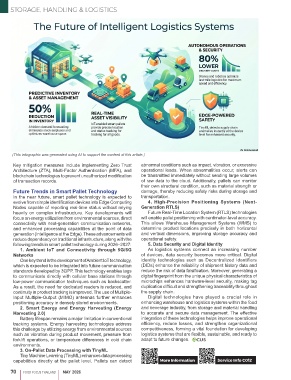
             (This infographic was generated using AI to support the content of this article.)
             Key mitigation measures include implementing Zero Trust   abnormal conditions such as impact, vibration, or excessive
             Architecture (ZTA), Multi-Factor Authentication (MFA), and   operational loads. When abnormalities occur, alerts can
             blockchain technologies to prevent unauthorized modification   be transmitted immediately without sending large volumes
             of transaction records.                              of raw data to the cloud. Additionally, pallets can monitor
                                                                  their own structural condition, such as material strength or
             Future Trends in Smart Pallet Technology             damage, thereby reducing safety risks during storage and
             In the near future, smart pallet technology is expected to   transportation.
             evolve from simple identification devices into Edge Computing   4.  High-Precision  Positioning  Systems  (Next-
             Nodes capable of reporting real-time status without relying   Generation RTLS)
             heavily on complex infrastructure. Key developments will   Future Real-Time Location System (RTLS) technologies
             focus on energy utilization from environmental sources, direct   will enable pallet positioning with centimeter-level accuracy.
             connectivity with next-generation communication networks,   This allows Warehouse Management Systems (WMS) to
             and enhanced processing capabilities at the point of data   determine product locations precisely in both horizontal
             generation (Intelligence at the Edge). These advancements will   and vertical dimensions, improving storage accuracy and
             reduce dependency on traditional infrastructure, along with the   operational safety.
             following trends in smart pallet technology during 2026–2027:  5. Data Security and Digital Identity
                1. Ambient  IoT  and  Connectivity  through  5G/6G   As logistics systems connect an increasing number
             Networks                                             of devices, data security becomes more critical. Digital
                One key trend is the development of Ambient IoT technology,   identity technologies such as Decentralized Identifiers
             which is expected to be integrated into future communication   (DIDs) enhance the reliability of shipment history data and
             standards developed by 3GPP. This technology enables tags   reduce the risk of data falsification. Moreover, generating a
             to communicate directly with cellular base stations through   digital fingerprint from the unique physical characteristics of
             low-power communication techniques such as backscatter.   microchips enhances hardware-level security, making tag
             As a result, the need for dedicated readers is reduced, and   duplication difficult and strengthening traceability throughout
             continuity in product tracking is improved. The use of Multiple-  the supply chain.
             Input Multiple-Output (MIMO) antennas further enhances   Digital  technologies  have  played  a  crucial  role  in
             positioning accuracy in densely stored environments.  enhancing warehouse and logistics systems within the food
                2. Smart Energy and Energy Harvesting (Energy     and beverage industry, from storage and material handling
             Harvesting 2.0)                                      to accurate and secure data management. The effective
                Battery lifespan remains a major limitation in conventional   integration of these technologies helps improve operational
             tracking systems. Energy harvesting technologies address   efficiency, reduce losses, and strengthen organizational
             this challenge by utilizing energy from environmental sources   competitiveness, forming a vital foundation for developing
             such as vibration during product movement, pressure from   logistics systems that are flexible, sustainable, and ready to
             forklift operations, or temperature differences in cold chain   adapt to future changes.
             environments.
                3. On-Pallet Data Processing with TinyML
                Tiny Machine Learning (TinyML) enhances data processing
             capabilities directly at the pallet level. Pallets can detect   More Information     Service Info C012

            70   FOOD FOCUS THAILAND  MAY  2026


                                                                                                                     23/4/2569 BE   09:00
         67-70_Storage_ logistic_������ RFID.indd   70                                                               23/4/2569 BE   09:00
         67-70_Storage_ logistic_������ RFID.indd   70

