


Page 65 - FoodFocusThailand No.241 May 2026
P. 65
STRA
                                                                                                     STRATEGIC R & DTEGIC R & D


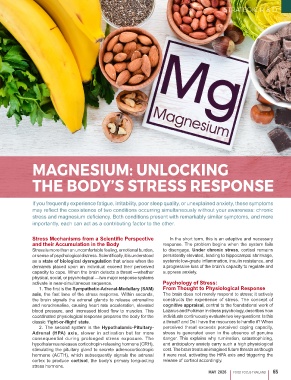
                     MAGNESIUM: UNLOCKING


                     THE BODY’S STRESS RESPONSE


                     If you frequently experience fatigue, irritability, poor sleep quality, or unexplained anxiety, these symptoms
                     may reflect the coexistence of two conditions occurring simultaneously without your awareness: chronic
                     stress and magnesium deficiency. Both conditions present with remarkably similar symptoms, and more
                     importantly, each can act as a contributing factor to the other.


                     Stress Mechanisms from a Scientific Perspective          In the short term, this is an adaptive and necessary
                     and their Accumulation in the Body                    response. The problem begins when the system fails
                     Stress is more than an uncomfortable feeling, emotional burden,   to disengage. Under chronic stress, cortisol remains
                     or sense of psychological distress. Scientifically, it is understood   persistently elevated, leading to hippocampal shrinkage,
                     as a state of biological dysregulation that arises when the   systemic low-grade inflammation, insulin resistance, and
                     demands placed upon an individual exceed their perceived   a progressive loss of the brain’s capacity to regulate and
                     capacity to cope. When the brain detects a threat —whether   suppress anxiety.
                     physical, social, or psychological —two major response systems
                     activate in near-simultaneous sequence.               Psychology of Stress:
                        1. The first is the Sympathetic-Adrenal-Medullary (SAM)   From Thought to Physiological Response
                     axis, the fast lane of the stress response. Within seconds,   The brain does not merely respond to stress; it actively
                     the brain signals the adrenal glands to release adrenaline   constructs the experience of stress. The  concept of
                     and noradrenaline, causing heart rate acceleration, elevated   cognitive appraisal, central to the foundational work of
                     blood pressure, and  increased blood flow to muscles. This   Lazarus and Folkman in stress psychology, describes how
                     coordinated physiological response prepares the body for the   individuals continuously evaluate two key questions: Is this
                     classic ‘fight-or-flight’ state.                      a threat? and Do I have the resources to handle it? When
                        2. The second system is the  Hypothalamic-Pituitary-  perceived threat exceeds perceived coping capacity,
                     Adrenal (HPA) axis, slower in activation but far more   stress is generated even in the absence of genuine
                     consequential  during  prolonged  stress  exposure.  The   danger. This explains why rumination, catastrophizing,
                     hypothalamus releases corticotropin-releasing hormone (CRH),   and anticipatory anxiety carry such a high physiological
                     stimulating the pituitary gland to secrete adrenocorticotropic   cost. The brain treats an imagined future threats as though
                     hormone (ACTH), which subsequently signals the adrenal   it were real, activating the HPA axis and triggering the
                     cortex to produce cortisol, the body’s primary long-acting   release of cortisol accordingly.
                     stress hormone.
                                                                                              MAY  2026  FOOD FOCUS THAILAND  65


                                                                                                                     23/4/2569 BE   08:01
         62-66_Strategic R&D_������.indd   65                                                                        23/4/2569 BE   08:01
         62-66_Strategic R&D_������.indd   65

