


Page 62 - FoodFocusThailand No.243 July 2026
P. 62
This phenomenon has important
                                                                                implications for individuals with IBS and
                                                                                heightened FODMAP sensitivity. Although
                                                                                RS is considered a beneficial dietary fiber,
                                                                                its colonic fermentation may increase gas
                                                                                production and bloating in some patients.
                                                                                Consequently, some experts recommend
                                                                                limiting RS intake to help manage IBS-
                                                                                related symptoms. This recommendation
                                                                                is supported by a study by So et al.
                                                                                (2022), which assessed RS tolerance in
                                                                                individuals with IBS and healthy controls.
                                                                                Participants consumed RS together with
                                                                                low-FODMAP foods, including bagasse,
                                                                                with daily increases in fiber intake over
                                                                                three consecutive days. Although overall
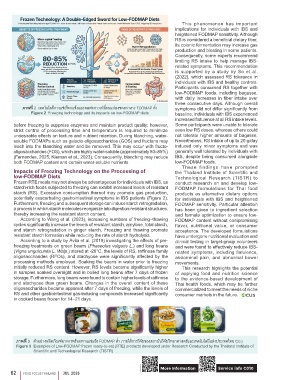
                 ภาพที่่� 2  เทคโนโลยีีการแช่่เยีือกแข็็งและผลต่่อการเปลี�ยีนแปลงข็องอาหาร FODMAP ต่ำ�า  symptoms did not differ significantly from
                     Figure 2  Freezing technology and its impacts on low-FODMAP diets  baseline, individuals with IBS experienced
                                                                                increased flatulence at all RS intake levels.
             before freezing to suppress enzymes and maintain product quality; however,   Some participants were unable to tolerate
             strict control of processing time and temperature is required to minimize   even low RS doses, whereas others could
             undesirable effects on texture and nutrient retention. During blanching, water-  not tolerate higher amounts of bagasse.
             soluble FODMAPs such as galacto-oligosaccharides (GOS) and fructans may   Nevertheless, RS intake of up to 20 g/day
             leach into the blanching water and be removed. This may occur with fructo-  induced only minor symptoms and was
             oligosaccharides (FOS), which are highly water-soluble (approximately 80–85%)   generally well tolerated by individuals with
             (Fernandes, 2025; Kiernan et al., 2023). Consequently, blanching may reduce   IBS, despite being consumed alongside
             both FODMAP content and certain water-soluble nutrients.           low-FODMAP foods.
                                                                                   These  findings  have  prompted
             Impacts of Freezing Technology on the Processing of                the Thailand Institute of Scientific and
             low-FODMAP Diets                                                   Technological Research (TISTR) to
             Frozen RTE meals may not always be advantageous for individuals with IBS, as   conduct research on and develop low-
             starch-rich foods subjected to freezing can exhibit increased levels of resistant   FODMAP formulations for  Thai food
             starch (RS). Excessive consumption thereof may promote gas production,   products as alternative dietary options
             potentially exacerbating gastrointestinal symptoms in IBS patients (Figure 2).   for individuals with IBS and heightened
             Furthermore, freezing and subsequent storage can induce starch retrogradation,   FODMAP sensitivity. Particular attention
             a process in which starch molecules reorganize into digestion-resistant structures,   has been given to ingredient selection
             thereby increasing the resistant starch content.                   and formula optimization to ensure low-
                According to Wang et al. (2023), increasing numbers of freezing–thawing   FODMAP content without compromising
             cycles significantly increase the levels of resistant starch, amylose, total starch,   flavor,  nutritional  value,  or  consumer
             and starch retrogradation in ginger starch. Freezing and thawing promote   acceptance. The developed formulations
             resistant starch formation while reducing the rate of starch hydrolysis.  have undergone nutritional evaluation and
                According to a study by Ávila et al. (2019) investigating the effects of pre-  clinical testing in target-group volunteers
             freezing treatments on green beans (Phaseolus vulgaris L.) and long beans   and were found to effectively reduce IBS-
             (Vigna unguiculata L. Walp.) stored at -20°C, the levels of RS, raffinose family   related symptoms, including flatulence,
             oligosaccharides (RFOs), and stachyose were significantly affected by the   abdominal  pain, and  abnormal  bowel
             processing methods employed. Soaking the beans in water prior to freezing   movements.
             initially reduced RS content. However, RS levels became significantly higher   This research highlights the potential
             in samples soaked overnight and in boiled long beans after 7 days of frozen   of applying food and nutrition science
             storage. Furthermore, long beans were found to contain higher levels of raffinose   to the evidence-based development of
             and stachyose than green beans. Changes in the overall content of these   Thai health foods, which may be further
             oligosaccharides became apparent after 7 days of freezing, while the levels of   commercialized to meet the needs of niche
             RS and other gastrointestinal gas-inducing compounds increased significantly   consumer markets in the future.
             in cooked beans frozen for 14–21 days.


              ภาพที่่� 3   ต่ัวอยี่างผลิต่ภััณฑ์์อาหารพร้อมทานแช่่แข็็ง FODMAP ต่ำ�า ภัายีใต่้การวิจััยีข็องสถาบัันวิจััยีวิทยีาศาสต่ร์และเทคโนโลยีีแห่งประเทศไทยี (วว.)
              Figure 3  Examples of Low-FODMAP frozen ready-to-eat (RTE) products developed under Research Conducted by the Thailand Institute of
                      Scientific and Technological Research (TISTR)


                                                                          More Information        Service Info C010
            62   FOOD FOCUS THAILAND  JUL  2026


                                                                                                                     23/6/2569 BE   17:10
         58-62_��������� 2.indd   62                                                                                 23/6/2569 BE   17:10
         58-62_��������� 2.indd   62

