


Page 73 - FoodFocusThailand No.243 July 2026
P. 73
SOURCE OF ENGINEER


                        2. Identifying Improvement Priorities               Level 3: Recycling
                        Once organizations understand which stages generate   When waste cannot be directly reused, recycling offers
                     the greatest impacts or losses, they can prioritize investments   an opportunity to recover its remaining value. For example,
                     and process improvements more effectively.          vegetable scraps, fruit peels, and production residues can be
                        3. Supporting ESG and Net Zero Goals             processed into compost or soil conditioners. Such practices
                        Data generated through LCA can be used to calculate a   align closely with the principles of the circular economy.
                     product’s carbon footprint, providing essential information for   Level 4: Recovery
                     Environmental, Social, and Governance (ESG) reporting and   Waste that cannot be reused or recycled may be converted
                     for developing greenhouse gas reduction strategies aligned   into thermal energy or electricity. This approach helps reduce
                     with Net Zero commitments.                          waste volumes, decreases reliance on fossil fuels, and
                                                                         improves resource efficiency within organizations.
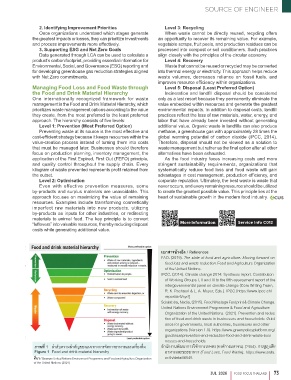
                     Managing Food Loss and Food Waste through              Level 5: Disposal (Least Preferred Option)
                     the Food and Drink Material Hierarchy                  Incineration and landfill disposal should be considered
                     One internationally recognized framework for waste   only as a last resort because they permanently eliminate the
                     management is the Food and Drink Material Hierarchy, which   value embedded within resources and generate the greatest
                     prioritizes waste management options according to the value   environmental impacts. In addition to disposal costs, landfill
                     they create, from the most preferred to the least preferred   practices reflect the loss of raw materials, water, energy, and
                     approach. The hierarchy consists of five levels:    labor that have already been invested without generating
                        Level 1: Prevention (Most Preferred Option)      additional value. Organic waste in landfills can also produce
                        Preventing waste at its source is the most effective and   methane, a greenhouse gas with approximately 28 times the
                     cost-efficient strategy because it keeps resources within the   global warming potential of carbon dioxide (IPCC, 2014).
                     value-creation process instead of turning them into costs   Therefore, disposal should not be viewed as a solution to
                     that must be managed later. Businesses should therefore   waste management but rather as the final option after all other
                     focus on production planning, inventory management, the   alternatives have been exhausted.
                     application of the First Expired, First Out (FEFO) principle,   As the food industry faces increasing costs and more
                     and quality control throughout the supply chain. Every   stringent  sustainability  requirements,  organizations  that
                     kilogram of waste prevented represents profit retained from   systematically reduce food loss and food waste will gain
                     the outset.                                         advantages in cost management, production efficiency, and
                        Level 2: Optimisation                            corporate reputation. Ultimately, the best waste is waste that
                        Even  with  effective  prevention  measures,  some                      never occurs, and every remaining resource should be utilized
                     by-products and surplus materials are unavoidable. This   to create the greatest possible value. This principle lies at the
                     approach focuses on maximizing the value of remaining   heart of sustainable growth in the modern food industry.
                     resources. Examples include transforming cosmetically
                     imperfect  raw  materials  into  new  products,  utilizing
                     by-products as inputs for other industries, or redirecting
                     materials to animal feed. The key principle is to convert
                     “leftovers” into valuable resources, thereby reducing disposal   More Information    Service Info C012
                     costs while generating additional value.


                                                                           เอกสารอ้างอิง / References
                                                                           FAO. (2019). The state of food and agriculture: Moving forward on
                                                                             food loss and waste reduction. Food and Agriculture Organization
                                                                             of the United Nations.
                                                                           IPCC. (2014). Climate change 2014: Synthesis report. Contribution
                                                                             of Working Groups I, II and III to the fifth assessment report of the
                                                                             intergovernmental panel on climate change (Core Writing Team,
                                                                             R. K. Pachauri & L. A. Meyer, Eds.). IPCC.[https://www.ipcc.ch/
                                                                             report/ar5/syr/]
                                                                           Scialabba, Nadia. (2015). Food Wastage Footprint & Climate Change.
                                                                           United Nations Environment Programme & Food and Agriculture
                                                                             Organization of the United Nations. (2021). Prevention and reduc
                                                                             tion of food and drink waste in businesses and households: Guid
                                                                             ance for governments, local authorities, businesses and other
                                                                             organizations (Version 1.0). https://www.greenpolicyplatform.org/
                                                                             guidance/prevention-and-reduction-food-and-drink-waste-busi
                                                                             nesses-and-households
                      ภาพที่่� 1   ลำำ�ดัับค์วิ�มสำำ�ค์ัญของแนัวิท�งก�รจััดัก�รอ�ห�รแลำะเค์ร่�องดั่�ม   สำำ�นัักง�นัพััฒนั�ก�รวิิจััยก�รเกษตร (องค์์ก�รมห�ชนั). (2564). การสููญเสูีย
                      Figure 1  Food and drink material hierarchy            อาหารและขยะอาหาร (Food Loss, Food Waste). https://www.arda.
                      ที่่�มา / Source: United Nations Environment Programme and Food and Agriculture Organization     or.th/detail/6545
                      of the United Nations (2021)
                                                                                               JUL  2026  FOOD FOCUS THAILAND  73


                                                                                                                     22/6/2569 BE   20:18
         70-73_Source of_wast ��������.indd   73
         70-73_Source of_wast ��������.indd   73                                                                     22/6/2569 BE   20:18

