


Page 72 - FoodFocusThailand No.243 July 2026
P. 72
SOURCE
            SOURCE OF ENGINEER OF ENGINEER


            LIFE CYCLE ASSESSMENT (LCA):


            TURNING HIDDEN COSTS INTO OPPORTUNITIES

            FOR PROFIT AND SUSTAINABILITY


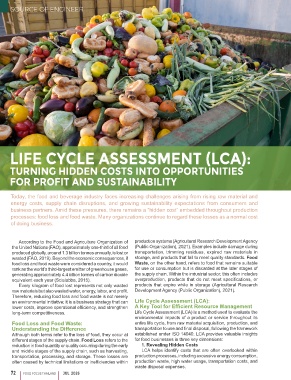
            Today, the food and beverage industry faces increasing challenges arising from rising raw material and
            energy costs, supply chain disruptions, and growing sustainability expectations from consumers and
            business partners. Amid these pressures, there remains a “hidden cost” embedded throughout production
            processes: food loss and food waste. Many organizations continue to regard these losses as a normal cost
            of doing business.


               According to the Food and Agriculture Organization of   production systems (Agricultural Research Development Agency
             the United Nations (FAO), approximately one-third of all food   (Public Organization), 2021). Examples include damage during
             produced globally, around 1.3 billion tonnes annually, is lost or   transportation, trimming residues, expired raw materials in
             wasted (FAO, 2019). Beyond the economic consequences, if   storage, and products that fail to meet quality standards. Food
             food loss and food waste were considered a country, it would   Waste, on the other hand, refers to food that remains suitable
             rank as the world’s third-largest emitter of greenhouse gases,   for use or consumption but is discarded at the later stages of
             generating approximately 4.4 billion tonnes of carbon dioxide   the supply chain. Within the industrial sector, this often includes
             equivalent each year (Scialabba, 2015).            overproduction, products that do not meet specifications, or
               Every kilogram of food lost represents not only wasted   products that expire while in storage (Agricultural Research
             raw materials but also wasted water, energy, labor, and profit.   Development Agency (Public Organization), 2021).
             Therefore, reducing food loss and food waste is not merely
             an environmental initiative; it is a business strategy that can   Life Cycle Assessment (LCA):
             lower costs, improve operational efficiency, and strengthen   A Key Tool for Efficient Resource Management
             long-term competitiveness.                         Life Cycle Assessment (LCA) is a method used to evaluate the
                                                                environmental impacts of a product or service throughout its
             Food Loss and Food Waste:                          entire life cycle, from raw material acquisition, production, and
             Understanding the Difference                       transportation to use and final disposal, following the framework
             Although both terms refer to the loss of food, they occur at   established under ISO 14040. LCA provides valuable insights
             different stages of the supply chain. Food Loss refers to the   for food businesses in three key dimensions:
             reduction in food quantity or quality occurring during the early   1. Revealing Hidden Costs
             and middle stages of the supply chain, such as harvesting,   LCA helps identify costs that are often overlooked within
             transportation, processing, and storage. These losses are   production processes, including excessive energy consumption,
             often caused by technical limitations or inefficiencies within   production waste, high water usage, transportation costs, and
                                                                waste disposal expenses.
            72   FOOD FOCUS THAILAND  JUL  2026


                                                                                                                     23/6/2569 BE   12:28
         70-73_Source of_wast ��������.indd   72                                                                     23/6/2569 BE   12:28
         70-73_Source of_wast ��������.indd   72

