


Page 66 - FoodFocusThailand No.244 August 2026
P. 66
physical, chemical, and microbiological quality, while
                                                                     confirming that the concentration and efficacy of
                                                                     bioactives remain consistent with intended health claims
                                                                     throughout the product’s shelf life.

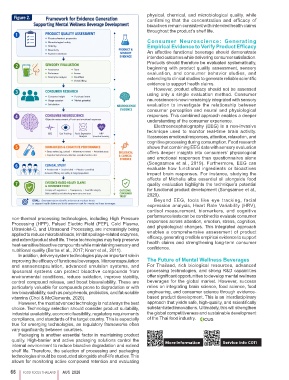
                                                                     Consumer Neuroscience: Generating
                                                                     Empirical Evidence to Verify Product Efficacy
                                                                     An effective functional beverage should demonstrate
                                                                     intended outcomes while delivering consumer satisfaction.
                                                                     Products should therefore be evaluated systematically,
                                                                     beginning with product quality assessment, sensory
                                                                     evaluation,  and  consumer  behavior  studies,  and
                                                                     extending to clinical studies to generate reliable scientific
                                                                     evidence to support health claims.
                                                                        However, product efficacy should not be assessed
                                                                     using only a single evaluation method. Consumer
                                                                     neuroscience is now increasingly integrated with sensory
                                                                     evaluation  to  investigate  the  relationship  between
                                                                     consumer perception and neural and physiological
                                                                     responses. This combined approach enables a deeper
                                                                     understanding of the consumer experience.
                                                                        Electroencephalography (EEG) is a non-invasive
                                                                     technique  used  to  monitor  real-time  brain  activity.
                                                                     It assesses emotional responses, attention, relaxation,  and
                                                                     cognitive processing during consumption. Food research
                                                                     shows that combining EEG data with sensory evaluation
                                                                     offers deeper insights into consumers’ physiological
                                                                     and emotional responses than questionnaires alone
                                                                     (Songsamoe et al., 2019). Furthermore, EEG can
                                                                     evaluate how functional ingredients or bioactives
                                                                     impact  brain  responses.  For  instance,  studying  the
                                                                     effects of Michelia alba essential oil alongside food
                                                                     quality evaluation highlights the technique’s potential
                                                                     for functional product development (Songsamoe et al.,
                                                                     2020).
                                                                        Beyond EEG, tools like eye tracking, facial
                                                                     expression analysis, Heart Rate Variability (HRV),
                                                                     cortisol measurement, biomarkers, and cognitive
                                                                     performance tests can be combined to evaluate consumer
             non-thermal processing technologies, including High Pressure
             Processing (HPP), Pulsed Electric Field (PEF), Cold Plasma,   responses across attention, emotion, stress, cognition,
             Ultraviolet-C, and Ultrasound Processing, are increasingly being   and physiological changes. This integrated approach
             applied to reduce microbial loads, inhibit spoilage-related enzymes,   enables a comprehensive assessment of product
             and extend product shelf life. These technologies may help preserve   efficacy, generating credible empirical evidence to support
             heat-sensitive bioactive compounds while maintaining sensory and   health claims and strengthening long-term consumer
             nutritional quality (Barba et al., 2017; Knorr et al., 2011).  confidence.
               In addition, delivery system technologies play an important role in
             improving the efficacy of functional beverages. Microencapsulation   The Future of Mental Wellness Beverages
             and  nanoencapsulation,  advanced  emulsion  systems,  and   For  Thailand, rich biological resources, advanced
             liposomal systems can protect bioactive compounds from   processing technologies, and strong R&D capabilities
             environmental conditions, reduce oxidation, improve stability,   offer significant opportunities to develop mental wellness
             control compound release, and boost bioavailability. These are   beverages for the global market. However, success
             particularly valuable for compounds prone to degradation or with   relies on integrating brain science, food science, food
             low bioavailability, such as polyphenols, probiotics, and fat-soluble   engineering, and consumer science through evidence-
             vitamins (Choi & McClements, 2020).                     based product development. This is an interdisciplinary
               However, the most advanced technology is not always the best   approach that yields safe, high-quality, and scientifically
             choice. Technology selection should consider product suitability,   substantiated innovations. Ultimately, this will strengthen
             industrial availability, economic feasibility, regulatory requirements   the global competitiveness and sustainable development
             compliance, and standards of the target country. This is especially   of the Thai food industry.
             true for emerging technologies, as regulatory frameworks often
             vary significantly between countries.
               Packaging is another essential factor in maintaining product
             quality. High-barrier and active packaging solutions control the
             internal environment to reduce bioactive degradation and extend   More Information      Service Info C011
             shelf life. Therefore, the selection of processing and packaging
             technologies should be conducted alongside shelf-life studies. This
             allows for monitoring active compound retention and evaluating

            66   FOOD FOCUS THAILAND  AUG  2026


                                                                                                                     25/7/2569 BE   17:02
         62-66_��������� 2_������.indd   66
         62-66_��������� 2_������.indd   66                                                                          25/7/2569 BE   17:02

