


Page 40 - FoodFocusThailand No.245 September 2026
P. 40
SMART PRODUCTION

           Superior  Quality  Retention  and  Operational
           Benefits of CFMH
              1. Preserve Product Quality and Flavor: Volumetric
           microwave heating enables products to reach the target
           temperature rapidly, reducing holding time. This can minimize
           the loss of heat-sensitive nutrients, such as vitamin C and
           polyphenols, as well as volatile flavor compounds, helping
           products retain their natural color, aroma, and flavor.
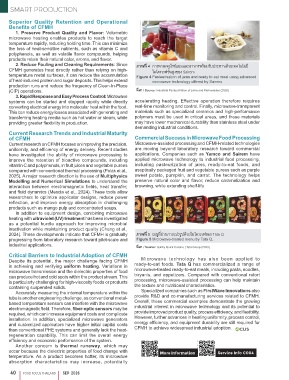
              2. Reduce Fouling and Cleaning Requirements: Since   ภาพที่่� 4  การพาสเจอไรซ์์แยมและอาหารพร้อมรับประทานด้้วยเทคโนโลยี
           CFMH generates heat directly rather than relying on high-     ไมโครเวฟขั้ั�นสูงขั้อง Sairem
           temperature metal surfaces, it can reduce the accumulation   Figure 4 Pasteurisation of jams and ready to eat meal using advanced
           of heat-induced protein and sugar deposits. This helps extend      microwave technology offered by Sairem
           production runs and reduce the frequency of Clean-In-Place
           (CIP) operations.                                    ที่่�มา / Source: Industrial Pasteurization of Jams and Marmelades (2020)
              3. Rapid Response and Easy Process Control: Microwave
           systems can be started and stopped rapidly while directly   accelerating heating. Effective operation therefore requires
           converting electrical energy into molecular heat within the food.   real-time monitoring and control. Finally, microwave-transparent
           This can reduce energy losses associated with generating and   materials such as specialized ceramics and high-performance
           transferring heating media such as hot water or steam, while   polymers must be used in critical areas, and these materials
           providing greater flexibility in production.         may have lower mechanical durability than stainless steel under
                                                                demanding industrial conditions.
           Current Research Trends and Industrial Maturity
           of CFMH                                              Commercial Success in Microwave Food Processing
           Current research on CFMH focuses on improving the precision,   Microwave-assisted processing and CFMH-related technologies
           uniformity, and efficiency of energy delivery. Recent studies   are moving beyond laboratory research toward commercial
           have investigated the ability of microwave processing to   applications. Companies such as Yamco and Sairem have
           improve the retention of bioactive compounds, including   applied microwave technology to industrial food processing,
           vitamin C and polyphenols, in fruit juices and vegetable purees   including  pasteurization of  jams,  ready-to-eat  foods,  and
           compared with conventional thermal processing (Polak et al.,   aseptically packaged fruit and vegetable purees such as purple
           2025). A major research direction is the use of Multiphysics   sweet  potato,  pumpkin,  and  carrot. The  technology  helps
           Modelling and Numerical Simulations to understand the   preserve natural color and flavor, reduce caramelization and
           interaction between electromagnetic fields, heat transfer,   browning, while extending shelf-life.
           and fluid dynamics (Mescia et al., 2024). These tools allow
           researchers to optimize applicator designs, reduce power
           reflection, and improve energy absorption in challenging
           products such as mango pulp and concentrated soups.
              In addition to equipment design, combining microwave
           heating with ultraviolet (UV) treatment has been investigated
           as a potential hurdle approach for improving microbial
           inactivation while maintaining product quality (Chang et al.,
           2024). These developments indicate that CFMH is gradually   ภาพที่่� 5  เมนูที�ผ่่านการแปรรูปด้้วยไมโครเวฟขั้อง Tata Q
           progressing from laboratory research toward pilot-scale and   Figure 5 Microwave-treated menu by Tata Q.
           industrial applications.
                                                                ที่่�มา / Source: Quirky Quick Cuisine | Tata Group (2020)
           Critical Barriers to Industrial Adoption of CFMH
           Despite its potential, the major challenge facing CFMH   Microwave  technology  has  also  been  applied  to
           is achieving and verifying uniform heating. Variations in   ready-to-eat foods.  Tata Q  has commercialized a range of
           microwave transmission and the dielectric properties of food   microwave-treated ready-to-eat meals, including pasta, noodles,
           can produce hot and cold spots within the product stream. This   biryanis, and appetizers. Compared with conventional retort
           is particularly challenging for high-viscosity foods or products   processing, microwave-assisted processing can help maintain
           containing suspended solids.                         the texture and nutritional characteristics.
              Accurately measuring the internal temperature within the   Specialized companies such as FirstWave Innovations also
           tube is another engineering challenge, as conventional metal-  provide R&D and co-manufacturing services related to CFMH.
           based temperature sensors can interfere with the microwave   Overall, these commercial examples demonstrate the growing
           electromagnetic field. Therefore, fiber-optic sensors may be   industrial interest in microwave technology and its potential to
           required, which can increase equipment costs and complicate   provide improved product quality, process efficiency, and flexibility.
           installation. In addition, specialized microwave generators   However, further advances in heating uniformity, process control,
           and customized applicators have higher initial capital costs   energy efficiency, and equipment durability are still required for
           than conventional PHE systems and generally lack the heat-  CFMH to achieve widespread industrial adoption.
           regeneration capability. This can limit the overall energy
           efficiency and economic performance of the system.
              Another  concern  is  thermal  runaway,  which  may
           occur because the dielectric properties of food change with    More Information        Service Info C004
           temperature. As a product becomes hotter, its microwave
           absorption characteristics may increase, potentially

            40   FOOD FOCUS THAILAND  SEP  2026


                                                                                                                     25/8/2569 BE   16:10
         36-40_Smat Production_CMU.indd   40
         36-40_Smat Production_CMU.indd   40                                                                         25/8/2569 BE   16:10

