


Page 49 - FoodFocusThailand No.245 September 2026
P. 49
STRONG QC & QA
                   เทคโนโลยีี In-Line pH Sensor
                   เพื่่�อคุณภาพื่และความปลอดภัยี    REAL-TIME IN-LINE pH
                   ของนมหมัก                         MONITORING:
                   บริิษััทได้้เสนอแนวทางในการิตริวจวัด้ค่่า
                   pH แบบอินไลน์ โด้ยใช้้เซนเซอริ์ pH ท่�มี่  PRECISION PROCESS CONTROL

                   ค่วามีค่งทนและไมี่แตกหัักง่าย ช้่วยใหั้  IN FERMENTED DAIRY
                   สามีาริถติด้ตามีกริะบวนการิหัมีักได้้อย่าง  Accurate pH monitoring is essential for producing high-quality fermented
                   ต่อเน่�องริวมีถึงลด้ค่วามีเส่�ยงจากการิปนเป้�อน  dairy products, as the pH level directly impacts flavor, texture, and shelf
                                                     life. Traditional pH measuring methods rely on labor- and time-intensive
                   ของแก้ว โด้ยเซนเซอริ์  สามีาริถติด้ตั�งได้้  sampling, and can produce inconsistent results. In-line pH measurement
                                   1
                   โด้ยตริงภายในถังหัมีักริ่วมีกับชุ้ด้ติด้ตั�งแบบ  with a food safe sensor enables precise process control and improved
                   ค่งท่�  เพื่่�อค่วามีแมี่นยำาทางวิศวกริริมี และ  product quality.
                      2
                   สามีาริถตริวจวัด้ค่่า pH ได้้อย่างต่อเน่�อง  Fermentation of milk using fermentation cultures is a well-established process
                   ตลอด้กริะบวนการิ  ทำาใหั้ผู้้้ปฏิิบัติงาน  with a long history. While traditionally focused on nutrient preservation, modern dairy
                   สามีาริถติด้ตามีค่่า pH ได้้แบบเริ่ยลไทมี์   production primarily aims to optimize sensory qualities such as flavor and texture.
                                                     pH control remains a critical parameter throughout fermentation, directly influencing
                   และสามีาริถปริับค่วามีเริ็วของกริะบวนการิ  product stability and quality.
                   หัมีักได้้ เช้่น การิปริับอุณหัภ้มีิใหั้เหัมีาะสมี   Dairy Fermentation Process
                   นอกจากน่� การิตริวจติด้ตามีค่่า pH แบบ                Specific, defined cultures of mainly lactic acid bacteria are used to produce fermented
                                                     dairy products. These bacteria convert the lactose in milk into lactic acid, which lowers
                   อินไลน์ยังช้่วยใหั้สามีาริถหัยุด้กริะบวนการิ              the pH from around 6.5 to approximately 4.5. This acidification causes milk proteins to
                                                     coagulate, thickening the milk. The lower pH, reduced sugar content, and increased
                   หัมีักได้้อย่างแมี่นยำาเมี่�อถึงค่่าท่�กำาหันด้   physical stability make the product less vulnerable to contamination by harmful microbes,
                   ทำาใหั้ผู้ลิตภัณฑ์์มี่คุ่ณภาพื่ท่�เหัมีาะสมีก่อน  thus extending its shelf life.
                   เข้าส้่กริะบวนการิบริริจุ         Importance of pH Control
                             1
                      เซนเซอริ์   ริองริับกริะบวนการิทำา           The pH value is the key parameter for monitoring and controlling fermentation. Missing
                                                     the optimal pH point can result in poor product quality. The fermentation process is
                   ค่วามีสะอาด้แบบ Clean-in-Place (CIP) จึง       typically stopped by cooling when the desired pH level is reached. Until now, this step
                   สามีาริถติด้ตั�งอย้่ภายในถังได้้ตลอด้  has relied heavily on frequent sampling near the end of fermentation, which requires
                                                     significant labor and product loss. In addition, off-line measurements create a time lag,
                   กริะบวนการิทำาค่วามีสะอาด้ โด้ยเซนเซอริ์  and if a sample is taken late and there is a delay before the sample is analyzed, product
                                                     quality will be affected.
                   ยังสามีาริถตริวจวัด้ได้้อย่างแมี่นยำาใน  In-Line pH Sensor Technology for the Quality and Safety of
                   ริะหัว่างกริะบวนการิ CIP โด้ยหัลังจาก         Fermented Dairy Products
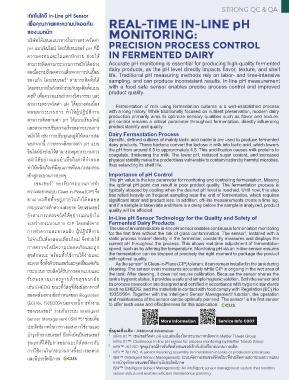
                   การิทำาค่วามีสะอาด้แล้ว  ผู้้้ปฏิิบัติงาน                The use of an unbreakable in-line pH sensor enables continuous fermentation monitoring
                                                     for the first time without the risk of glass contamination. The sensor , installed with a
                                                                                                             1
                   ไมี่จำาเป็นต้องสอบเท่ยบใหัมี่ จึงช้่วยใหั้           static process holder  directly in the fermenter, constantly measures and displays the
                                                                      2
                   การิตริวจวัด้มี่ค่วามีปลอด้ภัยและถ้ก  current pH throughout the process. This allows real-time adjustment of fermentation
                                                     speed, such as by altering the temperature. Monitoring pH via an in-line sensor ensures
                   สุขลักษัณะ พื่ริ้อมีทั�งใช้้งานได้้ง่ายและ  the fermentation can be stopped at precisely the right moment to package the product
                   สะด้วก ซึ�งทั�งตัวเซนเซอริ์และจุด้เช้่�อมีต่อกับ  with optimal quality.
                                                        As the sensor  is Clean-in-Place (CIP) tolerant, it can remain installed in the tank during
                                                                   1
                   กริะบวนการิผู้ลิตได้้ริับการิออกแบบและ  cleaning. The sensor even measures accurately while CIP is ongoing in the wet area of
                                                     the tank. After cleaning, it does not require calibration. Because the sensor shares the
                   ริับริองตามีมีาตริฐานด้้านสุขอนามีัย   tank’s hygienic status, it provides a safe and simple hygienic solution. Both the sensor and
                   เช้่น EHEDG ขณะท่�วัสดุ้ท่�สัมีผู้ัสอาหัาริก็  its process connection are designed and certified in accordance with hygienic standards
                                                     such as EHEDG, and the materials in contact with food comply with Regulation (EC) No
                   สอด้ค่ล้องตามีข้อกำาหันด้ของ Regulation   1935/2004. Together with the Intelligent Sensor Management function, the operation
                                                                                                        3
                                                                                                             1
                   (EC) No. 1935/2004 นอกจากน่� การิทำางาน  and maintenance of the sensor can be optimally planned. The sensor  is the first sensor
                                                     to offer such ease and effectiveness for this application.
                   ของเซนเซอริ์¹ ริ่วมีกับริะบบ Intelligent
                   Sensor Management (ISM™)³ ช้่วยเพื่ิ�มี                 More Information        Service Info C007
                   ปริะสิทธิิภาพื่ในการิวางแผู้นการิใช้้งานและ
                   บำาริุงริักษัาเซนเซอริ์ อ่กทั�งยังเป็นเซนเซอริ์  ข้้อมููลเพิ่่�มูเติ่มู / Additional Information
                                                       InPro X1™: เซนเซอริ์วัด้ค่่า pH แบบต่อเน่�องในกริะบวนการิผู้ลิตจาก Mettler Toledo Group
                                                     1
                   ริุ่นแริกท่�ได้้ริับการิออกแบบใหั้เหัมีาะกับ      InPro X1™: Continuous in-line pH sensor for process monitoring by Mettler Toledo Group.
                                                       InFit™ 761 NC: ชุ้ด้อุปกริณ์สำาหัริับติด้ตั�งเซนเซอริ์เข้ากับถังหัริ่อกริะบวนการิผู้ลิต
                                                     2
                   การิใช้้งานในกริะบวนการิน่�อย่างสะด้วก    InFit™ 761 NC: A sensor mounting assembly for installation in tanks or production processes.
                   และมี่ปริะสิทธิิภาพื่             3   ISM™ (Intelligent Sensor Management): ริะบบจัด้การิเซนเซอริ์อัจฉริิยะท่�ช้่วยติด้ตามีสถานะและวางแผู้น
                                                       การิบำาริุงริักษัาเซนเซอริ์ได้้อย่างมี่ปริะสิทธิิภาพื่
                                                       ISM™ (Intelligent Sensor Management): An intelligent sensor management system that monitors
                                                       sensor status and enables efficient maintenance planning.


                                                                                                                     25/8/2569 BE   16:52
         48-49_Strong QC&QA_Mettler.indd   49                                                                        25/8/2569 BE   16:52
         48-49_Strong QC&QA_Mettler.indd   49

