


Page 50 - FoodFocusThailand No.247 November_December 2026
P. 50
STRONG QC & QA


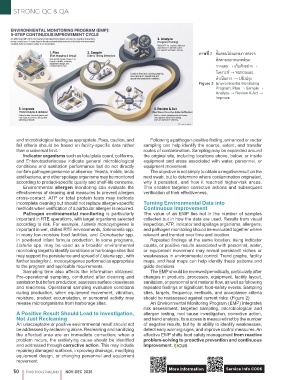
                                                                                         ภาพที่่� 2   ขั้้�นตอนโปรแกรมการตรวจ
                                                                                                 ติดตามสภาพแวดล้้อม:
                                                                                                 วางแผน → เก็บต้วอย่่าง →
                                                                                                 วิเคราะห์์ → ทบทวนแล้ะ
                                                                                                 ดำาเนินการ  → ปร้บปรุง
                                                                                         Figure 2  Environmental Monitoring
                                                                                                 Program: Plan → Sample →
                                                                                                 Analyze → Review & Act →
                                                                                                 Improve


             and microbiological testing as appropriate. Pass, caution, and   Following a pathogen-positive finding, enhanced or vector
             fail criteria should be based on facility-specific data rather   sampling can help identify the source, extent, and transfer
             than a universal limit.                              routes of contamination. Sampling may be expanded around
                Indicator organisms such as total plate count, coliforms,   the original site, including locations above, below, or inside
             and Enterobacteriaceae indicate general microbiological   equipment and areas associated with water, personnel, or
             conditions and sanitation performance but do not directly   equipment movement.
             confirm pathogen presence or absence. Yeasts, molds, lactic   The objective is not simply to obtain a negative result on the
             acid bacteria, and other spoilage organisms may be monitored   next swab, but to determine where contamination originated,
             according to product-specific quality and shelf-life concerns.  why it persisted, and how it reached higher-risk areas.
                Environmental  allergen  monitoring can evaluate the   This enables targeted corrective actions and subsequent
             effectiveness of cleaning and measures to prevent allergen   verification of their effectiveness.
             cross-contact. ATP or total protein tests may indicate
             incomplete cleaning but should not replace allergen-specific   Turning Environmental Data into
             methods when verification of a particular allergen is required.  Continuous Improvement
                Pathogen  environmental  monitoring  is  particularly   The value of an EMP lies not in the number of samples
             important in RTE operations, with target organisms selected   collected but in how the data are used. Results from visual
             according to risk. For example, Listeria monocytogenes is   inspection, ATP, indicator and spoilage organisms, allergens,
             important in wet, chilled RTE environments, Salmonella spp.   and pathogen monitoring should be evaluated together where
             in many low-moisture food facilities, and Cronobacter spp.   relevant and trended over time and location.
             in powdered infant formula production. In some programs,   Repeated findings at the same location, rising indicator
             Listeria spp. may be used as a broader environmental   counts, or positive results associated with personnel, water,
             monitoring target to identify conditions or harborage sites that   or equipment movement may reveal persistent niches or
             may support the persistence and spread of Listeria spp., with   weaknesses in environmental control. Trend graphs, facility
             further testing for L. monocytogenes performed as appropriate   maps, and heat maps can help identify these patterns and
             to the program and applicable requirements.          guide decisions.
                Sampling  time  also  affects  the  information  obtained.              The EMP should be reviewed periodically, particularly after
             Pre-operational  sampling,  conducted  after  cleaning  and   changes in products, processes, equipment, facility layout,
             sanitation but before production, assesses surface cleanliness   sanitation, or personnel and material flow, as well as following
             and readiness. Operational sampling evaluates conditions   repeated findings or significant food-safety events. Sampling
             during production, when equipment movement, vibration,   sites, targets, frequency, methods, and acceptance criteria
             moisture, product accumulation, or personnel activity may   should be reassessed against current risks. (Figure 2)
             release microorganisms from harborage sites.            An Environmental Monitoring Program (EMP) integrates
                                                                  risk assessment, targeted sampling, microbiological and
             A Positive Result Should Lead to Investigation,      allergen testing, root cause investigation, corrective action,
             Not Just Recleaning                                  and trend analysis. Its success is measured not by the number
             An unacceptable or positive environmental result should not   of negative results, but by its ability to identify weaknesses,
             be addressed by recleaning alone. Recleaning and sanitizing   detect early warning signs, and improve control measures. An
             the affected area are an immediate correction; when a   effective EMP shifts food safety management from reactive
             problem recurs, the underlying cause should be identified   problem-solving to proactive prevention and continuous
             and addressed through corrective action. This may include   improvement.
             repairing damaged surfaces, improving drainage, modifying
             equipment design, or changing personnel and equipment
             movement.

            50   FOOD FOCUS THAILAND  NOV-DEC  2026                          More Information        Service Info C006


                                                                                                                    23/10/2569 BE   18:58
         46-50_Strong QC&QA_������.indd   50                                                                        23/10/2569 BE   18:58
         46-50_Strong QC&QA_������.indd   50

