


Page 65 - FoodFocusThailand No.242 June 2026
P. 65
STRONG QC & QA

                    A PROACTIVE APPROACH TO LABORATORY SAFETY:
                    AUTOMATION AND COMPLIANCE


                    Automation has provided scientists with a powerful tool for achieving more accurate and consistent results
                    while improving operator safety and reducing fatigue. Automation has revolutionized the field of laboratory
                    analysis by reducing operator influence over sample preparation, collection, and evaluation of datasets.


                    Automation for Smarter Laboratory Operations         Database Systems for Enhancing Laboratory
                    By enhancing reproducibility across replicates, batches, or  Safety
                    sites, automation improves accuracy and confidence in any   To operate automation systems effectively, data must be
                    measurement or series of measurements. This powerful   transmitted to “databases” for systematic storage and
                    strategy toward data consistency involves converting manual,   management. However, storing data in files or paper poses
                    subjective processes into automated, objective ones. One of   significant challenges to data safety. Collecting data on
                    the key advantages of automation is the ability to generate   paper  is  primarily  unstructured,  and  sharing  it  is  difficult.
                    richer datasets than would be achievable manually in the   Data stored in files is often scattered across various folders,
                    same timeframe, allowing chemists and engineers to record   making them susceptible to loss, misplacement, unwanted
                    detailed experimental data while simultaneously interrogating   copies, modifications, or deletions without leaving a trace.
                    multiple parameters of interest. These rich datasets enable   This heightens the difficulty of detecting malicious activities or
                    researchers to analyze trends and make informed decisions   unauthorized access.
                    toward improved process design, all with less effort.  Databases provide a centralized and organized method of
                                                                         storing data, ensuring consistency and security. Features like
                    Integration of PAT, QbD, and Risk Assessment         backup and recovery, transaction management, and access
                    for Robust Inspection Systems                        control further fortify data safety, reducing the risks of loss or
                    To further enhance the intelligence of automation systems,   corruption. Moreover, databases enforce data integrity and
                    Process Analytical Technology (PAT), the Quality by Design   accuracy with constraints and validations that guarantee the
                    (QbD) approach, and Risk Assessment are interrelated tools   data remains accurate, consistent, and complete. This aspect
                    that play a crucial role in effectively improving process safety.  is vital for preventing errors and inaccuracies that may arise in
                       PAT enables real-time monitoring and measurement of   file-based systems. Databases are also ideal when access to
                    processes, while QbD is a framework for designing quality   data needs to be fast and reliable, as they provide scalability,
                    from the outset by defining and controlling key process   performance, and efficiency for retrieving and processing large
                    parameters to achieve the desired outcomes. Risk Assessment,   amounts of data.
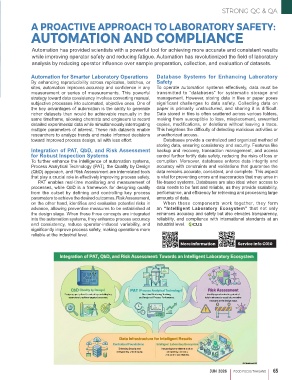
                    on the other hand, identifies and evaluates potential risks in   When these components work together, they form
                    advance, allowing preventive measures to be established at   an  “Intelligent Laboratory Ecosystem”  that not only
                    the design stage. When these three concepts are integrated   enhances accuracy and safety but also elevates transparency,
                    into the automation systems, they enhance process accuracy   reliability, and compliance with international standards at an
                    and consistency, reduce operator-induced variability, and   industrial level.
                    significantly improve process safety, making operations more
                    reliable at the industrial level.

                                                                                   More Information        Service Info C010


                                                                                               J JUN  2026UN  2026  FOOD FOCUS THAILAND  65 65
                                                                                                         FOOD FOCUS THAILAND

                                                                                                                     22/5/2569 BE   15:12
         64-65_Strong QC&QA_Mettler.indd   65
         64-65_Strong QC&QA_Mettler.indd   65                                                                        22/5/2569 BE   15:12

