


Page 43 - FoodFocusThailand No.243 July 2026
P. 43
SMART PRODUCTION


                     cured with salt, sugar, or spices and dried to improve smoke
                     adhesion. Hardwood species such as oak, apple, and maple
                     are preferred because they provide desirable flavors while
                     avoiding bitterness from wood resins. Today, these systems
                     typically separate the heat source from the smoking chamber
                     and deliver smoke through ducts.
                        2. Hot Smoking is commonly used for products such
                     as beef short ribs, brisket, smoked sausages, ham, smoked
                     chicken, smoked pork, and smoked fish. The hot smoking
                     process generally involves the following key steps:
                        - Brining: Soaking meat in a salt solution containing herbs
                     and spices to improve tenderness and juiciness.
                        - Trimming: Removing excess fat and connective tissue
                     to improve smoke penetration and product appearance.
                        - Smoking: Cooking the product at approximately
                     60–120°C until ready to eat. Barbecue products such as
                     pork ribs may be smoked at 110–120°C for 3–4 hours, while   Smoke Flavorings: Option for Consistency
                     larger cuts requiring exceptional tenderness may take 10
                     hours or longer.                                    Across Production Batches
                        Hot smoking is widely used because it cooks the product   1. Liquid Smoke  is a food additive produced by
                     while  simultaneously  imparting  smoky  flavor.  Smoke   condensing natural wood smoke into liquid form. It provides
                     compounds, particularly phenols and aldehydes, help inhibit   a flavor profile similar to traditional smoking and contains
                     microbial growth and extend shelf life. The resulting products   compounds such as phenols, organic acids, carbonyls, and
                     are tender, juicy, ready to eat, and often develop a dark   alcohols. It can be applied by spraying, dipping, or direct
                     outer crust known as “bark,” formed through the interaction   incorporation into products. Liquid smoke enables consistent
                     of smoke, heat, and seasonings.                     flavor development, shorter processing times, and easier
                        Common smoking materials include hardwoods such   quality control compared with traditional wood smoking.
                     as oak, beech, apple, and hickory, as well as agricultural   2. Smoke Powder is a flavoring ingredient designed
                     by-products including corn cobs, sugarcane bagasse,   to provide the aroma and taste of traditionally smoked
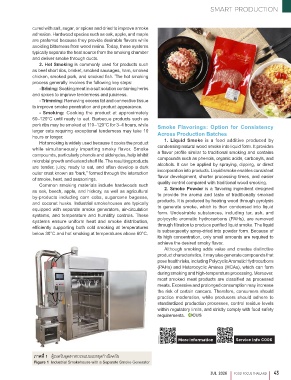
                     and coconut husks. Industrial smokehouses are typically   products. It is produced by heating wood through pyrolysis
                     equipped with separate smoke generators, air-circulation   to generate smoke, which is then condensed into liquid
                     systems, and temperature and humidity controls. These   form.  Undesirable  substances,  including  tar,  ash,  and
                     systems  ensure  uniform  heat  and  smoke  distribution,   polycyclic aromatic hydrocarbons (PAHs), are removed
                     efficiently supporting both cold smoking at temperatures   through filtration to produce purified liquid smoke. The liquid
                     below 30°C and hot smoking at temperatures above 60°C.  is subsequently spray-dried into powder form. Because of
                                                                         its high concentration, only small amounts are required to
                                                                         achieve the desired smoky flavor.
                                                                            Although smoking adds value and creates distinctive
                                                                         product characteristics, it may also generate compounds that
                                                                         pose health risks, including Polycyclic Aromatic Hydrocarbons
                                                                         (PAHs) and Heterocyclic Amines (HCAs), which can form
                                                                         during smoking and high-temperature processing. Moreover,
                                                                         most smoked meat products are classified as processed
                                                                         meats. Excessive and prolonged consumption may increase
                                                                         the risk of certain cancers. Therefore, consumers should
                                                                         practice moderation, while producers should adhere to
                                                                         standardized production processes, control residue levels
                                                                         within regulatory limits, and strictly comply with food safety
                                                                         requirements.


                                                                                  More Information        Service Info C006


                      ภาพที่่� 1  ตู้้�รมควัันอุุตู้สาหกรรมแบบแยกชุุดกำาเนิดควััน
                      Figure 1  Industrial Smokehouse with a Separate Smoke Generator

                                                                                               JUL  2026  FOOD FOCUS THAILAND  43


                                                                                                                     23/6/2569 BE   17:52
         40-43_Smart Production_��������.indd   43
         40-43_Smart Production_��������.indd   43                                                                   23/6/2569 BE   17:52

