


Page 60 - FoodFocusThailand No.244 August 2026
P. 60
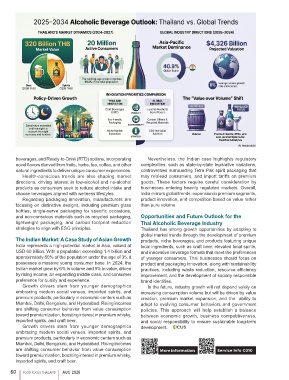
beverages, and Ready-to-Drink (RTD) options, incorporating   Nevertheless,  the  Indian  case  highlights  regulatory
              novel flavors derived from fruits, herbs, tea, coffee, and other   complexities, such as state-by-state legislative variations,
              natural ingredients to deliver unique consumer experiences.  controversies surrounding Tetra Pak spirit packaging that
                 Health-conscious  trends  are  also  shaping  market   may mislead consumers, and import tariffs on premium
              directions, driving interest in low-alcohol and no-alcohol   goods. These  factors  require  careful  consideration  by
              products as consumers seek to reduce alcohol intake and   businesses entering heavily regulated markets. Overall,
              choose beverages aligned with wellness lifestyles.  India mirrors global trends: expansion in premium segments,
                 Regarding packaging innovation, manufacturers are   product innovation, and competition based on value rather
              focusing on distinctive designs, including premium glass   than pure volume.
              bottles,  single-serve  packaging  for  specific  occasions,
              and eco-conscious materials such as recycled packaging,   Opportunities and Future Outlook for the
              lightweight  packaging,  and  carbon  footprint  reduction   Thai Alcoholic Beverage Industry
              strategies to align with ESG principles.            Thailand has strong growth opportunities by adapting to
                                                                  global market trends through the development of premium
              The Indian Market: A Case Study of Asian Growth     products, niche beverages, and products featuring unique
              India represents a high-potential market in Asia, valued at   local ingredients, such as craft beer, elevated local spirits,
              USD 60 billion. With a population exceeding 1.4 billion and   and innovative beverage formats that meet the preferences
              approximately 60% of the population under the age of 35, it   of younger consumers. Thai businesses should focus on
              possesses a massive young consumer base. In 2024, the   product and packaging innovation, along with sustainability
              Indian market grew by 6% in volume and 9% in value, driven   practices, including waste reduction, resource efficiency
              by rising income, an expanding middle class, and consumer   improvement, and the development of socially responsible
              preference for quality and experience.              brand identities.
                 Growth  drivers  stem  from  younger  demographics   In the future, industry growth will not depend solely on
              embracing modern social venues, imported spirits, and   increasing consumption volume but will be driven by value
              premium products, particularly in economic centers such as   creation, premium market expansion, and the  ability to
              Mumbai, Delhi, Bengaluru, and Hyderabad. Rising incomes   adapt to evolving consumer behaviors and government
              are shifting consumer behavior from value consumption   policies. This  approach  will  help  establish  a  balance
              toward premiumization, boosting interest in premium whisky,   between  economic  growth,  business  competitiveness,
              imported spirits, and craft beer.                   and social responsibility to ensure sustainable long-term
                 Growth  drivers  stem  from  younger  demographics   development.
              embracing modern social venues, imported spirits, and
              premium products, particularly in economic centers such as
              Mumbai, Delhi, Bengaluru, and Hyderabad. Rising incomes
              are shifting consumer behavior from value consumption       More Information        Service Info C010
              toward premiumization, boosting interest in premium whisky,
              imported spirits, and craft beer.

            60   FOOD FOCUS THAILAND  AUG  2026


                                                                                                                     25/7/2569 BE   16:11
         56-60_��������� 1_NFI.indd   60                                                                             25/7/2569 BE   16:11
         56-60_��������� 1_NFI.indd   60

