


Page 32 - FoodFocusThailand No.246 October 2026
P. 32
SPECIAL FOCUS
            SCOOP


              3 SODIUM REDUCTION INNOVATIONS:

              A NEW FRONTIER FOR THE HEALTH &

              WELLNESS FOOD INDUSTRY


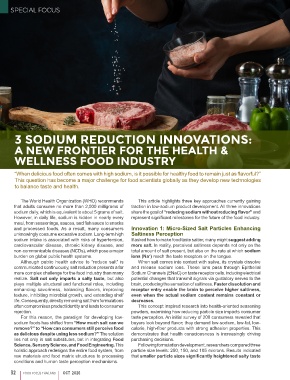
              “When delicious food often comes with high sodium, is it possible for healthy food to remain just as flavorful?”
              This question has become a major challenge for food scientists globally as they develop new technologies
              to balance taste and health.


                The World Health Organization (WHO) recommends   This article highlights three key approaches currently gaining
             that adults consume no more than 2,000 milligrams of   traction in low-sodium product development. All three innovations
             sodium daily, which is equivalent to about 5 grams of salt.   share the goal of “reducing sodium without reducing flavor” and
             However, in daily life, sodium is hidden in nearly every   represent significant milestones for the future of the food industry.
             meal, from seasonings, sauces, and fish sauce to snacks
             and processed foods. As a result, many consumers   Innovation 1: Micro-Sized Salt Particles Enhancing
             unknowingly consume excessive sodium. Long-term high   Saltiness Perception
             sodium intake is associated with risks of hypertension,   If asked how to make food taste saltier, many might suggest adding
             cardiovascular disease, chronic kidney disease, and   more salt. In reality, perceived saltiness depends not only on the
             non-communicable diseases (NCDs), which pose a major   total amount of salt present, but also on the rate at which sodium
             burden on global public health systems.          ions (Na ) reach the taste receptors on the tongue.
                                                                      +
                Although public health advice to “reduce salt” is   When salt comes into contact with saliva, its crystals dissolve
             communicated continuously, salt reduction presents a far   and release sodium ions. These ions pass through Epithelial
             more complex challenge for the food industry than many   Sodium Channels (ENaC) on taste receptor cells, inducing electrical
             realize. Salt not only imparts a salty taste, but also   potential changes that transmit signals via gustatory nerves to the
             plays multiple structural and functional roles, including   brain, producing the sensation of saltiness. Faster dissolution and
             enhancing  savoriness,  balancing  flavors,  improving   receptor entry enable the brain to perceive higher saltiness,
             texture, inhibiting microbial growth, and extending shelf   even when the actual sodium content remains constant or
             life. Consequently, directly removing salt from formulations   decreases.
             often compromises product identity and leads to consumer   This concept inspired research into health-oriented seasoning
             rejection.                                       powders, examining how reducing particle size impacts consumer
                For this reason, the paradigm for developing low-  taste perception. An initial survey of 200 consumers revealed that
             sodium foods has shifted from “How much salt can we   buyers look beyond flavor; they demand low-sodium, low-fat, low-
             remove?” to “How can consumers still perceive food   calorie, high-fiber products with strong adhesion properties. This
             as delicious despite using less sodium?” The solution   demonstrates that health consciousness is increasingly driving
             lies not only in salt substitutes, but in integrating Food   purchasing decisions.
             Science, Sensory Science, and Food Engineering. This   Following formulation development, researchers compared three
             holistic approach redesigns the entire food system, from   particle size levels: 250, 150, and 105 microns. Results indicated
             raw materials and food matrix structures to processing   that smaller particle sizes significantly heightened salty taste
             conditions and human taste perception mechanisms.

            32   FOOD FOCUS THAILAND  OCT  2026


                                                                                                                     23/9/2569 BE   10:01
         28-33_Special Focus_�������.indd   32                                                                       23/9/2569 BE   10:01
         28-33_Special Focus_�������.indd   32

