


Page 51 - FoodFocusThailand No.237 December 2025
P. 51
STRONG QC & QA


                                                                         liquid, and  gaseous samples. It requires minimal sample
                                                                         preparation and provides results much faster than many other
                                                                         analytical techniques. Consequently, it has been widely applied
                                                                         in fields such as materials analysis, forensic investigations,
                                                                         and non-invasive substance analysis without opening
                                                                         packaging.
                                                                            Vafakhah  et  al.  (2023)  applied  Raman  Spectroscopy
                                                                         combined with Chemometrics to develop a rapid, non-
                                                                         destructive, and accurate method for rice quality control
                                                                         and contamination detection. Raman Spectroscopy
                                                                         precisely analyzes the molecular composition of rice, while
                                                                         Chemometrics—particularly classification models such as
                                                                         Supervised Kohonen Map (SKM) and PLS-DA—processes
                                                                         complex spectral data to accurately classify rice varieties and
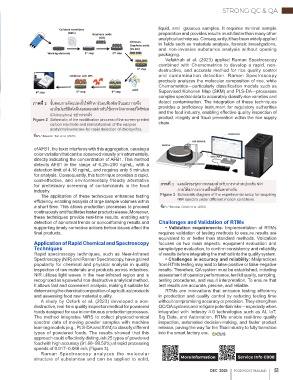
                     ภาพที่่� 2  ขั�นตอนการดัดแปลงขั�วไฟฟ้าค่าร์บอนพิิมพิ์สำกร่นและการตรึง  detect contamination. The integration of these techniques
                            เอนไซม์อะซิติลโค่ล่นเอสำเตอเรสำสำำาหรับใชุ้ตรวจวัดสำารค่ลอร์ไพิริฟอสำ   provides a proficiency instrument for regulatory authorities
                            (Chlorpyrifos) อย่างรวดเร็ว                  and the food industry, enabling effective quality inspection of
                     Figure 2  Schematic of the modification process of the screen-printed   product integrity and fraud prevention within the rice supply
                            carbon electrode and immobilization of the enzyme   chain.
                            acetylcholinesterase for rapid detection of chlorpyrifos.
                     ที่่�มา / Source: Tun et al. (2023)

                     of AFB1, the toxin interferes with this aggregation, causing a
                     color variation that can be observed visually or instrumentally,
                     directly indicating the concentration of AFB1. This method
                     detects AFB1 in the range of 6.25–200 ng/mL, with a
                     detection limit of 4.18 ng/mL, and requires only 5 minutes
                     for analysis. Consequently, this technique provides a rapid,
                     cost-effective,  and  environmentally  friendly  alternative
                     for  preliminary  screening  of  contaminants  in  the  food                                                                           ภาพที่่� 3   แผนผังของชุุดการทดลองสำำาหรับการหาค่่าสำเปกตรัม NIR
                     industry.                                                   ภายใต้สำภาวะการเค่ล่�อนท่�ท่�แตกต่างกัน
                        The application of these techniques enhances testing   Figure 3  Schematic diagram of the experimental setup for acquiring
                     efficiency, enabling analysis of large sample volumes within      NIR spectra under different motion conditions.
                     a short time. This allows production processes to proceed   ที่่�มา / Source: Ozturk et al. (2023)
                     continuously and facilitates faster product release. Moreover,
                     these techniques provide real-time results, enabling early
                     detection of abnormal trends or nonconforming results and   Challenges and Validation of RTMs
                     supporting timely corrective actions before issues affect the   • Validation requirements: Implementation of RTMs
                     final products.                                     requires validation of testing methods to ensure results are
                                                                         equivalent to or better than standard methods. Validation
                     Application of Rapid Chemical and Spectroscopy      focuses on two main aspects: equipment evaluation and
                     Techniques                                          sample-type evaluation, to confirm consistency and reliability
                     Rapid spectroscopy techniques, such as Near-Infrared   of results before integrating the method into the quality system.
                     Spectroscopy (NIR) and Raman Spectroscopy, have gained   • Challenges in accuracy and reliability: Malpractices
                     popularity for chemical and physical analysis in quality   from RTMs testing may lead to false-positive or false-negative
                     inspection of raw materials and products across industries.   results. Therefore, QA system must be established, including
                     NIR utilizes light waves in the near-infrared region and is   assessment of operator performance, test kit quality, sampling,
                     recognized as a powerful non-destructive analytical method.   testing procedures, and result interpretation. To ensure that
                     It allows fast and convenient analysis, making it suitable for   test results are accurate, precise, and reliable.
                     determining the chemical composition of agricultural products   RTMs are innovations that enhance testing efficiency
                     and assessing food raw material quality.            in production and quality control by reducing testing time
                        A  study  by  Ozturk  et  al.  (2023)  developed  a  non-  without compromising accuracy or precision. They strengthen
                     destructive, real-time quality inspection method for powdered   QC/QA systems and mitigate potential risks—especially when
                     foods designed for use in continuous production processes.   integrated with Industry 4.0 technologies such as AI, IoT,
                     The method integrates NIRS to collect physicochemical   Big Data, and Automation. RTMs enable real-time quality
                     spectral data of moving powder samples with machine   inspection, automated decision-making, and faster product
                     learning models (e.g., PLS-DA and SVM) to classify different   release, paving the way for the Thai industry to fully transition
                     types of powdered foods. The results showed that this   into the smart factory era.
                     approach could effectively distinguish 25 types of powdered
                     food with high accuracy (91.68–99.52%) at rapid processing
                     speeds of 0.017–0.068 m/s (Figure 3).
                        Raman Spectroscopy analyzes the molecular
                     structure  of  substances  and  can  be  applied  to  solid,   More Information      Service Info C008

                                                                                               DEC  2025  FOOD FOCUS THAILAND  51


                                                                                                                    25/11/2568 BE   07:53
         47-51_Strong QC&QA_CMU.indd   51                                                                           25/11/2568 BE   07:53
         47-51_Strong QC&QA_CMU.indd   51

