


Page 58 - FoodFocusThailand No.238 January-February 2026
P. 58
STRATEGIC R&D

                                                               The Unique Benefits of Fermented Vegetables for
                                                               Gut and Brain Health
                                                               Unlike dairy-based probiotics such as yogurt, fermented
                                                               vegetables are rich in diverse beneficial bacteria, as well as plant
                                                               compounds like polyphenols and fiber. This combination not only
                                                               supports a healthy gut and immune system but also enhance brain
                                                               function. Some fermented vegetables naturally contain GABA, a
                                                               calming neurotransmitter that helps regulate mood and promote
                                                               overall well-being.

                                                               Research  Highlights:  Fermented  Vegetables
                                                               Support Mood, Reduce Stress, and Promote Infant
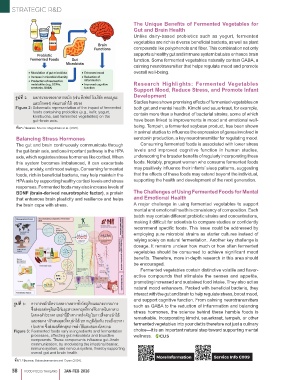
              รููปที่่� 2:   ผลกระทบของอาหารหมััก (เช่่น คีีเฟอร์ โยเกิร์ต คีอมับูฉะ   Development
                     และผักดอง) ต่อแกนลำาไส้้–ส้มัอง           Studies have shown promising effects of fermented vegetables on
              Figure 2: Schematic representation of the impact of fermented   both gut and mental health. Kimchi and sauerkraut, for example,
                     foods containing probiotics (e.g., kefir, yogurt,   contain more than a hundred of bacterial strains, some of which
                     kombucha, and fermented vegetables) on the
                     gut–brain axis.                           have been linked to improvements in mood and emotional well-
                                                               being. Tempeh, a fermented soybean product, has been shown
              ที่่�มา / Source: Source: Magalhães et al. (2025).
                                                               in animal studies to influence the expression of genes involved in
              Balancing Stress Hormones                        serotonin production, a key neurotransmitter for regulating mood.
              The gut and brain continuously communicate through   Consuming fermented foods is associated with lower stress
              the gut-brain axis, and one important pathway is the HPA   levels and improved cognitive function in human studies,
              axis, which regulates stress hormones like cortisol. When   underscoring the broader benefits of regularly incorporating these
              this system becomes imbalanced, it can exacerbate   foods. Notably, pregnant women who consume fermented foods
              stress, anxiety, and mood swings. Consuming fermented   may positively influence their infants’ sleep patterns, suggesting
              foods, rich in beneficial bacteria, may help maintain the   that the effects of these foods may extend beyond the individual,
              HPA axis by supporting healthy cortisol levels and stress   supporting the health and development of the next generation.
              responses. Fermented foods may also increase levels of
              BDNF (brain-derived neurotrophic factor), a protein   The Challenges of Using Fermented Foods for Mental
              that enhances brain plasticity and resilience and helps   and Emotional Health
              the brain cope with stress.                      A major challenge in using fermented vegetables to support
                                                               mental and emotional health is consistency of composition. Each
                                                               batch may contain different probiotic strains and concentrations,
                                                               making it difficult for scientists to compare studies or confidently
                                                               recommend specific foods. This issue could be addressed by
                                                               employing pure microbial strains as starter cultures instead of
                                                               relying solely on natural fermentation.  Another key challenge is
                                                               dosage. It remains unclear how much or how often fermented
                                                               vegetables should be consumed to achieve significant mood
                                                               benefits. Therefore, more in-depth research in this area should
                                                               be encouraged.
                                                                  Fermented vegetables contain distinctive volatile and flavor-
                                                               active compounds that stimulate the senses and appetite,
                                                               promoting increased and sustained food intake. They also act as
                                                               natural mood enhancers. Packed with beneficial bacteria, they
                                                               interact with the gut and brain to help regulate stress, boost mood,
                                                               and support cognitive function. From calming neurotransmitters
             รููปที่่� 3:   อาหารหมัักมัีคีวามัหลากหลายทั�งวัตถุุดิบและกระบวนการ   such as GABA to the reduction of inflammation and balancing
                    ซึ่่�งส้่งผลต่อจุุลินทรีย์และส้ารออกฤทธิ์ิ�ทางช่ีวภาพในอาหาร   stress hormones, the science behind these humble foods is
                    โดยองคี์ประกอบเหล่านี�มัีบทบาทส้ำาคีัญในการส้่�อส้ารลำาไส้้  remarkable. Incorporating kimchi, sauerkraut, tempeh, or other
                    และส้มัอง ปรับส้มัดุลเย่�อบุลำาไส้้ ระบบภูมัิคีุ้มักัน รวมัถุ่งระบบ
                    ประส้าท ซึ่่�งส้่งผลดีต่อสุ้ขภาพลำาไส้้และส้มัองโดยรวมั  fermented vegetables into your diet is therefore not just a culinary
             Figure 3: Fermented foods vary in ingredients and fermentation   choice—it is an important natural step toward supporting mental
                    processes, affecting gut microbiota and bioactive   wellness.
                    compounds. These components influence gut–brain
                    communication, by modulating the intestinal barrier,
                    immune system, and nervous system, thereby supporting
                    overall gut and brain health.
                                                                        More Information        Service Info C009
             ที่่�มา / Source: Balasubramanian and Cryan (2024).
            58   FOOD FOCUS THAILAND  JAN-FEB  2026


                                                                                                                     12/1/2569 BE   14:44
         55-58_Strategic R&D_CMU.indd   58                                                                           12/1/2569 BE   14:44
         55-58_Strategic R&D_CMU.indd   58

