


Page 74 - FoodFocusThailand No.238 January-February 2026
P. 74
STORAGE, HANDLING & LOGISTICS


             safe work practices. The key element of this standard is the   Collaboration between both sectors will take place as follows:
             determination of the “Recommended Weight Limit (RWL)”   1. Robots will be responsible for handling tasks associated
             under appropriate reference conditions (Ideal Conditions), as   with high Lifting Index (LI) values, such as bending to lift heavy
             outlined below:                                     milk cartons from the floor or reaching to place sugar bags on
                • Adult males: not exceeding 25 kilograms        shelves above shoulder height. They will also be capable of
                • Adult females: not exceeding 20 kilograms      walking on two legs through narrow pathways, similar to humans,
                • Youth aged 15–18 years: not exceeding 20 kilograms for   without experiencing fatigue or back injuries.
             males and 15 kilograms for females                     2. Humans will take on the role of “robot managers,” shifting
                Concepts of Risk Calculation and Assessment      from physical material handling to supervising and controlling
                To determine if a lifting task is safe, we must consider   robot operations via applications or extended reality (XR) devices.
             “attenuation  factors”  through  the  revised  NIOSH  lifting   Commands will be executed through digital twin systems. For
             equation, which has the following calculation formula:  tasks requiring high precision, such as arranging high-value
                                                                 wine bottles, workers will use smart gloves to guide robots in
                                                                 high-risk areas or in low-temperature environments, such as
                                                                 cold storage rooms.
                By:                                                  Future Predictions: From Robots to “Avatars” In the
                • LC (Load Constant): Weight constant (23-25 kg as per   near future, the role of robots may expand from serving
             standard)                                           merely as lifting aids to functioning as “avatars” or “second bodies”
                • Various Multipliers: such as distance from the body (H),   that further support human work in industrial sectors. In this
             lifting height (V), travel distance (D), twist angle (A), frequency   context, workers will be able to log in from home or on-site
             (F), and grip tightness (C).                        locations via high-speed networks to operate humanoid robotic
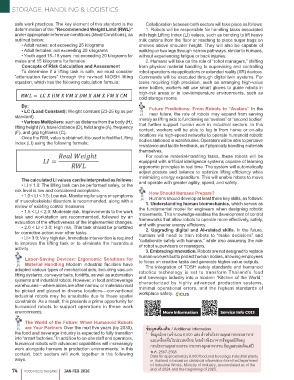
                Once the RWL value is obtained, it is used to find the Lifting   bodies stationed in warehouses. Operators will be able to perceive
             Index (LI) using the following formula:             resistance and tactile feedback, as if physically handling materials
                                                                 themselves.
                                                                    For routine material-handling tasks, these robots will be
                                                                 equipped with artificial intelligence systems capable of learning
                                                                 ergonomic principles in real time. The system will automatically
                                                                 adjust posture and balance to optimize lifting efficiency while
                                                                 minimizing energy expenditure. This will enable robots to move
                The calculated LI values can be interpreted as follows:  and operate with greater agility, speed, and safety.
                • LI ≤ 1.0: The lifting task can be performed safely, or the
             risk level is low and considered acceptable.            How Should Humans Prepare?
                • 1.0 < LI < 1.5: Low risk. Monitoring for signs or symptoms   Humans should develop at least three key skills, as follows:
             of musculoskeletal disorders is recommended, along with a   1. Understanding human biomechanics, which serves as
             review of existing control measures.                the fundamental model for engineers when designing robotic
                • 1.5 < LI < 2.0: Moderate risk. Improvements to the work   movements. This knowledge enables the development of control
             task and workstation are recommended, followed by an   frameworks that allow robots to operate more effectively, safely,
             evaluation of the effectiveness of the implemented changes.  and with greater energy efficiency.
                • 2.0 < LI < 3.0: High risk. This task should be prioritized   2. Upgrading digital and AI-related skills. In the future,
             for corrective action over other tasks.             humans will need to train robots to “make decisions” and
                • LI > 3.0: Very high risk. Immediate intervention is required   “collaborate safely with humans,” while also assuming the role
             to improve the lifting task or to eliminate the hazardous          of robot supervisors or managers.
             activity.                                              3. Embracing innovation. Robots are not designed to replace
                                                                 human workers but to protect human bodies, allowing employees
                 Labor-Saving Devices: Ergonomic Solutions for   to focus on creative tasks and generate higher-value outputs.
                 Material Handling Modern industrial facilities have   The integration of TOSH safety standards and humanoid
             adopted various types of mechanical aids, including vacuum   robotics  technology  is  set  to  transform  Thailand’s  food
             lifting systems, conveyor belts, forklifts, as well as automation   and beverage industry into a modern “Kitchen of the World,”
             systems and industrial robots. However, in food and beverage   characterized  by  highly  advanced  production  systems,
             warehouses—where aisles are often narrow, or materials must   minimal operational errors, and the highest standards of
             be picked and placed in diverse locations—conventional   workplace safety.
             industrial robots may be unsuitable due to these spatial
             constraints. As a result, this presents a prime opportunity for
             humanoid robots to support operations in these work
             environments.                                                 More Information        Service Info C013

                 The World of the Future: When Humanoid Robots
                 are Your Partners Over the next five years (by 2030),   ข้้อมููลเพิ่่�มูเติ่มู / Additional Information
             the food and beverage industry is expected to fully transition   1   ข้้อมููลโรงงานจำำานวน 8,000 แห่่ง สำำาห่รับโรงงานอุตสำาห่กรรมูอาห่าร
             into “smart factories.” In addition to on-site staff and operators,     และเคร่�องดื่่�มูในประเทศไทย โดื่ยอ้างอิงมูาจำากข้้อมููลสำถิิติข้อง
             humanoid robots with advanced capabilities will increasingly     กรมูโรงงานอุตสำาห่กรรมู กระทรวงอุตสำาห่กรรมู ข้้อมููลสำะสำมูตั�งแต่ปี
             work alongside humans in production environments. In this
             context,  both  sectors  will  work  together  in  the  following               พ.ศ. 2567-2568
                                                                      Data for approximately 8,000 food and beverage industrial plants
             ways.                                                    in Thailand is based on statistical information from the Department
                                                                      of Industrial Works, Ministry of Industry, accumulated as of the
            74   FOOD FOCUS THAILAND  JAN-FEB  2026                   end of 2024 and the beginning of 2025.


                                                                                                                     12/1/2569 BE   12:25
         70-74_StroageLogistic.indd   74                                                                             12/1/2569 BE   12:25
         70-74_StroageLogistic.indd   74

