


Page 47 - FoodFocusThailand No.241 May 2026
P. 47
SMART PRODUCTION


                        According to research, beers containing S. cerevisiae   Gluten-free beer exhibits distinctive flavor and aroma
                     var. boulardii and its variant strains, such as CNCM I-745, 3,   profiles compared to conventional beer: rice imparts a mild
                     146, 6, 7, 8, 10c, 2PV, AKP1, and CCMA 1746, demonstrate   flavor and less stable foam; oats contribute higher viscosity
                     enhanced resistance to gastric acidity, exhibit anti-  and may introduce undesirable aromas, while quinoa and
                     inflammatory properties, and promote improved interactions   buckwheat produce a more bitter taste and characteristic
                     with the host’s intestinal cells. Co-fermentation of S. boulardii   aromas. Enzymatic treatments can enhance flavor and aroma
                     CODEX with other S. cerevisiae strains has shown promising   quality, although they may also influence the fermentation
                     potential  in  alleviating  antibiotic-induced  diarrhea  and   process and increase the risk of contamination. 2
                     restoring gut microbiota balance. Additionally, fermentation
                     using S. cerevisiae UFMG A-905, a probiotic yeast, may help   Highly Antioxidant Beer
                     reduce gastrointestinal infections and lower mortality and   The incorporation of antioxidant-rich adjuncts, such as herbal
                     inflammation in Salmonella-infected rats. Meanwhile, beer   extracts, vegetables, mushrooms, and fruits, can enhance
                     fermented with S. cerevisiae var. boulardii CNCM I-745 has   both the health value and sensory profiles.
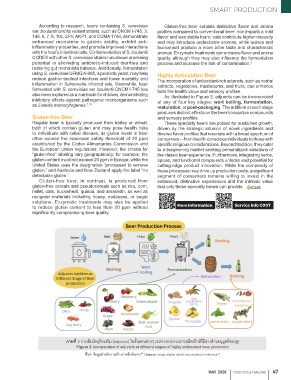
                     also been explored as a marinade for chicken, demonstrating   As illustrated in Figure 2, adjuncts can be incorporated
                     inhibitory effects against pathogenic microorganisms such   at any of four key stages: wort boiling, fermentation,
                     as Listeria monocytogenes. 7,15                     maturation, or post-packaging. The addition at each stage
                                                                         produces distinct effects on the beer’s bioactive compounds
                     Gluten-free Beer                                    and sensory profiles.
                     Regular beer is typically produced from barley or wheat,   These specialty beers are poised for sustained growth,
                     both of which contain gluten and may pose health risks   driven by the strategic infusion of novel ingredients and
                     to individuals with celiac disease, as gluten levels in beer   diverse flavor profiles that resonate with a broad spectrum of
                     often exceed the maximum safety threshold of 20 ppm   consumers—from health-conscious individuals to those with
                     established by the Codex Alimentarius Commission and   specific religious considerations. Beyond tradition, they cater
                     the European Union regulations. However, the criteria for   to a burgeoning market seeking personalized variations of
                     “gluten-free” labeling vary geographically; for example, the   the classic beer experience. Furthermore, integrating herbs,
                     gluten content must not exceed 20 ppm in Europe, while the   spices, and functional compounds unlocks vast potential for
                     United States uses the designation “processed to remove   cutting-edge product innovation. While the complexity of
                     gluten,” and Australia and New Zealand apply the label “no   these processes may drive up production costs, a significant
                     detectable gluten.”                                 segment of consumers remains willing to invest in the
                        Gluten-free  beer,  in  contrast,  is  produced  from                         enhanced, distinctive experiences and the intrinsic value
                     gluten-free cereals and pseudocereals such as rice, corn,   that only these specialty brews can provide.
                     millet, oats, buckwheat, quinoa, and amaranth, as well as
                     nongrain materials including honey, molasses, or sugar
                     solutions.  Enzymatic  treatments  may  also  be  applied
                     to  reduce  gluten  content  to  less  than  20  ppm  without   More Information    Service Info C007
                     significantly compromising beer quality.


                                   ภาพที่่� 2 การเติิมวััติถุุดิิบเสริม (adjuncts) ในขั้ั�นติอนติ่างๆ ระหวั่างกระบวันการผลิิติเบียร์ที่ี�มีสารติ้านอนุมูลิอิสระสูง
                                        Figure 2 Incorporation of adjuncts at different stages of highly antioxidant beer production
                                                                  10
                                           ที่่�มา: ขั้้อมูลิสำาหรับการสร้างภาพสืบค้้นจาก  / Source: Image citation details are provided in reference  10


                                                                                              MAY  2026  FOOD FOCUS THAILAND  47


                                                                                                                     23/4/2569 BE   08:32
         43-47_Smart Production_FIN.indd   47                                                                        23/4/2569 BE   08:32
         43-47_Smart Production_FIN.indd   47

