


Page 40 - FoodFocusThailand No.242 June 2026
P. 40
SPECIAL FOCUS


             color, texture, and potential contamination
             while robotic arms adjust their grip
             strength in real time (adaptive gripping),
             minimizing product damage and reducing
             dependence on manual labor.
               In seafood processing, CPSs are
             combined with X-ray scanning and
             hyperspectral imaging to detect bones,
             foreign objects, and freshness levels,
             significantly improving food safety and
             reducing consumer complaints.
               Smart Beverage Manufacturing
               Beverage  production  is  a  classic
             example of continuous-flow manufacturing
             where CPSs play a crucial role. Global
             companies such as Coca-Cola and Nestlé
             have developed smart beverage factory
             systems integrating sensors for Brix level
             measurement, pH monitoring, flow rate
             control, and automated Cleaning-in-Place
             (CIP) systems.
               These systems are  connected to
             cloud platforms and AI-based predictive
             models  that  enable  real-time  quality
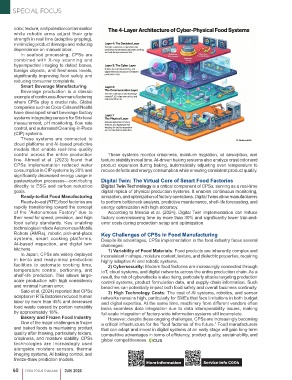
             control across the entire production   These systems monitor crispiness, moisture migration, oil absorption, and
             line. Ahmed et al. (2023) found that   texture stability in real time. AI-driven baking systems also analyze crust color and
             CPSs  implementation  reduced  water   product expansion during baking, automatically adjusting oven temperature to
             consumption in CIP systems by 20% and   reduce defects and energy consumption while ensuring consistent product quality.
             significantly decreased energy usage in
             pasteurization processes—contributing   Digital Twin: The Virtual Core of Smart Food Factories
             directly to ESG and carbon reduction   Digital Twin Technology is a critical component of CPSs, serving as a real-time
             goals.                              digital replica of physical production systems. It enables continuous monitoring,
               Ready-to-Eat Food Manufacturing   simulation, and optimization of factory operations. Digital Twins allow manufacturers
               Ready-to-eat (RTE) food factories are   to perform bottleneck analysis, predictive maintenance, shelf-life forecasting, and
             rapidly transitioning toward the concept   energy optimization with high accuracy.
             of  the  “Autonomous  Factory”  due  to   According to Mescia et al. (2024), Digital Twin implementation can reduce
             their need for speed, precision, and high   factory commissioning time by more than 30% and significantly lower trial-and-
             food safety standards. Key enabling   error costs during production setup and optimization.
             technologies include Autonomous Mobile
             Robots (AMRs), robotic pick-and-place   Key Challenges of CPSs in Food Manufacturing
             systems, smart cooking platforms,   Despite its advantages, CPSs implementation in the food industry faces several
             AI-based inspection, and digital twin   challenges:
             kitchens.                              1) Variability of Food Materials: Food products are inherently complex and
               In Japan, CPSs are widely deployed   inconsistent in shape, moisture content, texture, and dielectric properties, requiring
             in bento and ready-meal production   highly adaptive AI and robotic systems.
             facilities to automate cooking time,   2) Cybersecurity: Modern food factories are increasingly connected through
             temperature control, portioning, and   IoT, cloud systems, and digital networks across the entire production chain. As a
             shelf-life prediction. This allows large-  result, the risk of cyberattacks is also rising, particularly attacks targeting production
             scale production with high consistency   control systems, product formulation data, and supply chain information. Such
             and minimal human error.            breaches can potentially impact both food safety and overall business continuity.
               Sato et al. (2024) reported that CPSs   3) High Technology Costs: The cost of AI systems, robotics, and sensor
             adoption in RTE factories reduced human   networks remains high, particularly for SMEs that face limitations in both budget
             labor by more than 45% and decreased   and digital expertise. At the same time, machinery from different vendors often
             food waste caused by portion variability   lacks seamless data integration due to data interoperability issues, making
             by approximately 18%.               full-scale integration of factory-wide information systems still incomplete.
               Bakery and Frozen Food Industry      However, despite these ongoing challenges, CPSs are increasingly becoming
               One of the major challenges in frozen   a critical infrastructure for the “food factories of the future.” Food manufacturers
             and baked foods is maintaining product   that can adapt and invest in digital systems at an early stage will gain long-term
             quality after thawing, particularly texture,   competitive advantages in terms of efficiency, product quality, sustainability, and
             crispiness, and moisture stability. CPSs   global competitiveness.
             technologies are increasingly used
             alongside moisture sensors, thermal
             imaging systems, AI baking control, and
             freeze-thaw prediction models.
                                                                    More Information        Service Info C004
            40   FOOD FOCUS THAILAND  JUN  2026


                                                                                                                     22/5/2569 BE   18:16
         36-40_Special Focus_Tara.indd   40                                                                          22/5/2569 BE   18:16
         36-40_Special Focus_Tara.indd   40

