


Page 46 - FoodFocusThailand No.238 January-February 2026
P. 46
SUST
            SUSTAINABILITY DRIVENAINABILITY DRIVEN


            MODERN CLEAN ENERGY

            TECHNOLOGIES TOWARD


            THE FUTURE OF A SUSTAINABLE FOOD INDUSTRY


            The cold chain is considered the foundation of today’s modern trade system, particularly in the food and
            pharmaceutical industries. At the same time, it is one of the most energy-intensive sectors within the logistics
            system, accounting for approximately 30% of total logistics energy consumption.¹ This high energy demand,
            combined with a heavy reliance on fossil fuels, has resulted in significant environmental impacts, especially
            in terms of carbon dioxide emissions. In 2022, the food cold chain emitted greenhouse gases equivalent to
            1.32 gigatons of carbon dioxide, representing a twofold increase from 2000 and accounting for 3% of total
            global greenhouse gas emissions.²


               This article, therefore, aims to present emerging technologies   Alternative energy vehicles, such as electric vehicles
             that warrant close attention for reducing carbon dioxide   (EVs) and hydrogen vehicles (HVs), are technologies
             emissions, which play a crucial role in advancing the industry   that help reduce dependence on petroleum fuels, which
             toward long-term sustainability.                     are major sources of carbon dioxide emissions. However,
                                                                  the commercial adoption of electric vehicles in the cold chain
             Carbon-Reduction Technologies for a Sustainable      industry remains relatively limited compared with their use in
             Future                                               personal transportation. Range limitations, particularly when
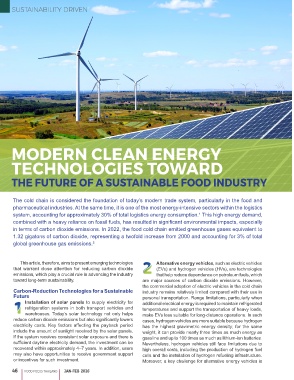
                 Installation of solar panels to supply electricity for   additional electrical energy is required to maintain refrigerated
                 refrigeration systems in both transport vehicles and   temperatures and support the transportation of heavy loads,
                 warehouses. Today’s solar technology not only helps   make EVs less suitable for long-distance operations. In such
             reduce carbon dioxide emissions but also significantly lowers   cases, hydrogen vehicles are more suitable because hydrogen
             electricity costs. Key factors affecting the payback period   has the highest gravimetric energy density; for the same
             include the amount of sunlight received by the solar panels.   weight, it can provide nearly three times as much energy as
             If the system receives consistent solar exposure and there is   gasoline and up to 100 times as much as lithium-ion batteries.
             sufficient daytime electricity demand, the investment can be   Nevertheless, hydrogen vehicles still face limitations due to
             recovered within approximately 4–7 years. In addition, users   high overall costs, including the production of hydrogen fuel
             may also have opportunities to receive government support   cells and the installation of hydrogen refueling infrastructure.
             or incentives for such investment.                   Moreover, a key challenge for alternative energy vehicles is

            46   FOOD FOCUS THAILAND  JAN-FEB  2026


                                                                                                                     13/1/2569 BE   11:39
         44-47_Sustainabili_�����.indd   46                                                                          13/1/2569 BE   11:39
         44-47_Sustainabili_�����.indd   46

