


Page 86 - FoodFocusThailand No.238 January-February 2026
P. 86
substances,  such  as  β-glucan,  immune  cells  are
                                                                       modified in their function, which involves increasing
                                                                       their reaction to subsequent stimulation (Art et al.,
                                                                       2018). It has been shown that the use of β-glucan
                                                                       in combination with chemotherapy can enhance the
                                                                       destruction of cancer cells.
                                                                          β-glucan has been extensively studied as a biological
                                                                       (Chan et al., 2009), directly interacting with immune-cell
                                                                       membrane receptors and inducing inflammation and
                                                                       potent immune responses to non-autoimmune antigens
                                                                       expressed  by  pathogens,  including  cancer  cells
                                                                       (Vos et al., 2007). The immunomodulatory properties
                                                                       of β-D-glucan have been extensively investigated,
                                                                       and it has been shown to have anticancer activity by
                                                                       enhancing the immune response to cancer cells and
                                                                       promoting angiogenesis (Wang et al., 2020). Several
                                                                       clinical  and  preclinical  studies  have  shown  that
                                                                       β-D-glucan can modify the responses and interactions
                                                                       between the innate and adaptive immune systems
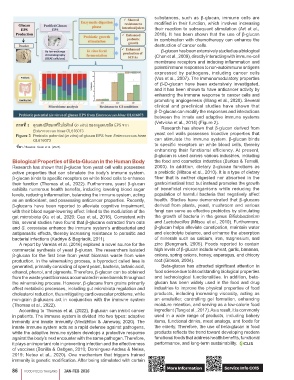
              ภาพที่่� 3   คุุณสมบััติิของพรีีไบัโอติิกส์ (in vitro) ของกลููแคุนชนิด EPS จาก   (Vetvicka et al., 2014) (Figure 2).
                                                                          Research has shown that β-glucan derived from
                     Enterococcus hirae OL616073
              Figure 3  Prebiotic potential (in vitro) of glucan EPS from Enterococcus hirae   yeast cell walls possesses bioactive properties that
                     OL616073                                          can stimulate the immune system. β-glucan binds
                                                                       to specific receptors on white blood cells, thereby
              ที่่�มา / Source: Swati et al. (2025)
                                                                       enhancing  their  functional  efficiency. At  present,
                                                                       β-glucan is used across various industries, including
            Biological Properties of Beta-Glucan in the Human Body     the food and cosmetics industries (Burkus & Temelli,
            Research has shown that β-glucan from yeast cell walls possesses   2000).  In  addition,  dietary  β-glucan  functions  as
            active properties that can stimulate the body’s immune system.   a prebiotic (Mitsou et al., 2010). It is a type of dietary
            β-glucan binds to specific receptors on white blood cells to enhance   fiber  that  is  neither  digested  nor  absorbed  in  the
            their function (Thomas et al., 2022). Furthermore, yeast β-glucan   gastrointestinal tract but instead promotes the growth
            exhibits numerous health benefits, including lowering blood sugar   of  beneficial  microorganisms  while  reducing  the
            levels, reducing inflammation, balancing the immune system, acting   population of harmful bacteria that negatively affect
            as an antioxidant, and possessing anticancer properties. Recently,   health. Studies have demonstrated that β-glucans
            β-glucans have been reported to alleviate cognitive impairment,   derived from plants, yeast, mushroom and various
            with their blood sugar-lowering effect linked to the modulation of the   fungi can serve as effective prebiotics by stimulating
            gut microbiota (Xu et al., 2020; Cao et al., 2016). Consistent with   the growth of bacteria in the genus Bifidobacterium
            this, several studies have found that β-glucans extracted from oats   and Lactobacillus (Mitsou et al., 2010). Furthermore,
            and S. cerevisiae enhance the immune system’s antibacterial and   β-glucan helps alleviate constipation, maintain water
            antiparasitic effects, thereby increasing resistance to parasitic and   and electrolyte balance, and enhance the absorption
            bacterial infections (Kadriye & Bagriacik, 2011).          of minerals such as calcium, iron, magnesium, and
               A report by Varelas et al. (2016) explored a novel source for the   zinc (Bengmark, 2005). Foods reported to contain
            commercial synthesis of yeast β-glucan. The researchers isolated   high levels of β-glucan include wheat, garlic, bananas,
            β-glucan for the first time from yeast biomass waste from wine   onions, spring onions, honey, asparagus, and chicory
            production. In the winemaking process, a byproduct called lees is   root (Gibson, 2004).
            generated, primarily consisting of spent yeast, bacteria, tartaric acid,   Beta-glucan has attracted significant attention in
            ethanol, phenol, and pigments. Therefore, β-glucan can be obtained   food science due to its outstanding biological properties
            from the waste yeast biomass accumulated in wine barrels throughout   and technological functionalities. In addition, beta-
            the winemaking process. However, β-glucans from grains primarily   glucan has been widely used in the food and drug
            affect metabolic processes, including gut microbiota regulation and   industries to improve the physical properties of food
            cholesterol reduction, thus mitigating cardiovascular problems, while   products,  including  increasing  viscosity,  acting  as
            non-grain β-glucans act in conjunction with the immune system   an emulsifier, controlling gel formation, enhancing
            (Thomas et al., 2022).                                     moisture retention, and serving as a low-calorie food
               According to Thomas et al. (2022), β-glucan can inhibit cancer   ingredient (Tang et al., 2017). As a result, it is commonly
            in patients. The immune system is divided into two types: adaptive   used in a wide range of products, including bakery
            immunity and innate immunity (Medzhitov & Janeway, 2020). The   items, functional drinks, meat analogs, and foods for
            innate immune system acts as a rapid defense against pathogens,   the elderly. Therefore, the use of beta-glucan in food
            while the adaptive immune system develops a protective response   products reflects the trend toward developing modern
            against the body’s next encounter with the same pathogen. Therefore,   functional foods that address health benefits, functional
            it plays an important role in preventing infection and the effectiveness   performance, and long-term sustainability.
            of vaccines (Bonilla & Oettgen, 2010; Dominguez-Andres & Netea,
            2019; Netea et al., 2020). One mechanism that triggers trained
            immunity is genetic modification. After being stimulated with certain

            86   FOOD FOCUS THAILAND  JAN-FEB  2026                          More Information        Service Info C015


                                                                                                                     12/1/2569 BE   13:31
         82-86_��������� 2.indd   86                                                                                 12/1/2569 BE   13:31
         82-86_��������� 2.indd   86

