


Page 53 - FoodFocusThailand No.240 April 2026
P. 53
STRATEGIC R & DTEGIC R & D
                                                                                                     STRA


                     ACTIVE LIFESTYLE:


                     A WAY OUT OF THE HEALTH CRISIS


                     IN AN AGE OF DECLINING PHYSICAL ACTIVITY


                     In the digital era, lifestyles have become increasingly sedentary due to greater reliance on motorized
                     transport and prolonged use of digital media. As a result, physical activity levels have declined significantly.
                     According to the World Health Organization, over 1.8 billion adults worldwide—approximately 31%—do not
                     meet the recommended physical activity levels, a figure that is projected to rise to 35% by 2030. This trend
                     contributes to the increasing prevalence of non-communicable diseases (NCDs) and rising healthcare costs.


                        The concept of an  active lifestyle,   are associated with obesity, diabetes, certain types of cancer, and cardiovascular
                     which integrates physical activity into daily   disease (Pinto et al., 2023; Dhondge et al., 2024).
                     routines, has therefore gained increasing   However, when the body engages in regular physical activity, several biological
                     attention. It emphasizes not only movement,   systems are activated to restore balance and function. The body then shifts toward
                     but also  proper  nutrition,  and  balance   a more active lifestyle. The key mechanisms involved are as follows:
                     across  the  body’s  systems,  including   1) Catecholamines are biochemical substances, including epinephrine
                     circulatory, digestive, and immune systems.   (adrenaline), norepinephrine (noradrenaline), and dopamine, which function
                     These practices help enhance quality of   as both neurotransmitters and hormones. When the body is stimulated by
                     life and reduce the long-term risk of NCDs   physical activity, the sympathetic nervous system signals the adrenal medulla to
                     (Sharma et al., 2024).                increase catecholamine release. This results in an increased heart rate, improved
                                                           blood circulation, enhanced alertness, and improved concentration (Aksoy
                     Active Lifestyle:                     et al., 2025).
                     From Inertia to Vitality
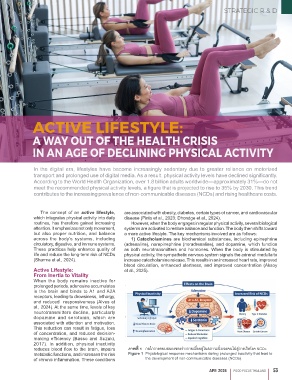
                     When the body remains inactive for
                     prolonged periods, adenosine accumulates
                     in the brain and binds to A1 and A2A
                     receptors, leading to drowsiness, lethargy,
                     and reduced  responsiveness (Alves et
                     al., 2024). At the same time, levels of key
                     neurotransmitters decline, particularly
                     dopamine  and  serotonin,  which  are
                     associated with attention and motivation.
                     This reduction can result in fatigue, loss
                     of concentration, and reduced decision-
                     making efficiency (Basso and Suzuki,
                     2017). In addition, physical inactivity
                     reduces blood flow to the brain, impairs   ภาพที่่� 1   กลไกการตอบสนองของร่างกายเมื่่�ออย่่ในสภาวะน่�งเฉยจนไปส่่การเก่ดโรค NCDs
                     metabolic functions, and increases the risk   Figure 1  Physiological response mechanisms during prolonged inactivity that lead to
                     of chronic inflammation. These conditions      the development of non-communicable diseases (NCDs).

                                                                                               APR  2026  FOOD FOCUS THAILAND  53


                                                                                                                     25/3/2569 BE   11:55
         50-54_Stratic R&D_CMU.indd   53                                                                             25/3/2569 BE   11:55
         50-54_Stratic R&D_CMU.indd   53

