


Page 33 - FoodFocusThailand No.244 August 2026
P. 33
SMART PRODUCTION

                     Table 1 Emulsification technologies and their applications in food products
                           Production              Emulsifier/                 Properties                Examples of
                           Technology         Encapsulating material         and functions              food products
                      High-speed stirring    Lecithin                 Forms a coarse emulsion and reduces   Salad  dressings,  sauces,  and
                                             Gum arabic               interfacial tension between oil and water  mayonnaise
                      High-pressure homogenization  Whey protein      Reduces emulsion droplet size, improves   Milk,  protein  beverages,  and  ice
                                             Casein                   droplet uniformity, and enhances emulsion   cream
                                             Pea protein              stability
                      Ultrasonic emulsification  Plant proteins       Produces fine emulsion droplets, enhances   Beverages, fruit juices, and sauces
                                                                      dispersion, and improves emulsion stability
                      Nanoemulsion technology  Lecithin               Enhances the solubility and bioavailability   Edible coatings, functional
                                             Whey protein             of bioactive compounds while improving   beverages, and dietary supplements
                                                                      emulsion stability
                      Microencapsulation technology  Encapsulating material: Maltodextrin,   Protects bioactive compounds, controls   Probiotics, vitamins, essential oils,
                                             Alginate, Gelatin, Pea protein  their release, and improves stability during   and flavor compounds
                                                                      processing and storage
                     Source: Santamaria-Echart et al. (2025); Ogbonna et al. (2025)


                     reduction, dispersion, emulsification, and
                     mixing. The  high  rotational  speed  creates
                     turbulent flow around the edge of the disc,
                     including vortex formation and up-and-down
                     fluid circulation, achieving uniform dispersion.
                        2. Homogenization is a process applied
                     to liquid or semi-liquid systems  to achieve
                     the uniform distribution of components at the
                     microscopic level. Its primary objective is to
                     reduce the size of particles, liquid droplets,   Innovation and Development of Emulsification Technology
                     or air bubbles and disperse them uniformly   Current innovations in emulsion technology are no longer limited to
                     throughout the continuous phase, thereby   stabilizing oil-water mixtures but have expanded to the protection of
                     improving the stability and homogeneity of   bioactive compounds, controlled release of active ingredients, and the
                     the system. Different types of homogenizers   extension of product shelf life. Among the most promising technologies
                     operate based on different principles. High-  are nanoemulsion technology and microencapsulation technology
                     pressure homogenizers use high pressure   (Table 1). Nanoemulsions, with droplet sizes ranging from approximately
                     to generate shear forces, impact forces, and   10–200 nm, are widely used as delivery systems for fat-soluble vitamins,
                     turbulent  flow,  causing  particles  or  liquid   antioxidants, essential oils, and flavoring agents. They are also applied
                     droplets to break into smaller sizes. In contrast,   in the development of edible coatings to extend the shelf life of fruits,
                     ultrasonic homogenizers utilize the cavitation   vegetables, and meat products. In contrast, microencapsulation is a
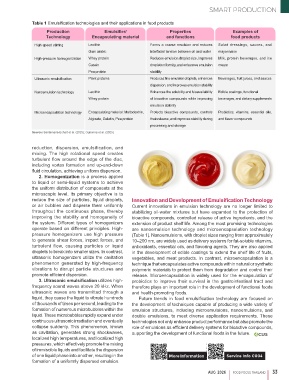
                     phenomenon  generated  by  high-frequency   technique that encapsulates active compounds within natural or synthetic
                     vibrations  to  disrupt  particle  structures  and   polymeric materials to protect them from degradation and control their
                     promote efficient dispersion.             release. Microencapsulation is widely used for the encapsulation of
                        3. Ultrasonic emulsification utilizes high-  probiotics to improve their survival in the gastrointestinal tract and
                     frequency sound waves above 20 kHz. When   therefore plays an important role in the development of functional foods
                     ultrasonic waves are transmitted through a   and health-promoting foods.
                     liquid, they cause the liquid to vibrate hundreds   Future  trends  in  food  emulsification  technology  are  focused  on
                     of thousands of times per second, leading to the   the development of techniques capable of producing a wide variety of
                     formation of numerous microbubbles within the   emulsion structures, including microemulsions, nanoemulsions, and
                     liquid. These microbubbles rapidly expand under   double emulsions, to meet diverse application requirements. These
                     continuous ultrasonic irradiation and eventually   technologies not only enhance product performance but also promote the
                     collapse suddenly. This phenomenon, known   role of emulsions as efficient delivery systems for bioactive compounds,
                     as cavitation, generates strong shockwaves,   supporting the development of functional foods in the future.
                     localized high temperatures, and localized high
                     pressures, which effectively promote the mixing
                     of immiscible liquids and facilitate the dispersion
                     of one liquid phase into another, resulting in the       More Information        Service Info C004
                     formation of a uniformly dispersed emulsion.

                                                                                               AUG  2026  FOOD FOCUS THAILAND  33


                                                                                                                     25/7/2569 BE   15:31
         29-33_Smart Production_����������.indd   33                                                                 25/7/2569 BE   15:31
         29-33_Smart Production_����������.indd   33

