


Page 38 - FoodFocusThailand No.244 August 2026
P. 38
STRONG QC & QA


                The use of nitrogen-to-protein conversion factors can   content. This approach provides both a more accurate
             introduce substantial errors into the reported protein content.   estimate  of  protein  content  and  the  amino  acid  profile
             The conventional factor of 6.25 is based on the assumption   required for calculating AAS and DIAAS. However, it is more
             that proteins contain, on average, 16% nitrogen. In reality, the   expensive, more time-consuming, and requires specialized
             nitrogen content varies among proteins from different food   procedures for certain amino acids. For example, tryptophan
             sources. Consequently, Jones factors, which are specific to   can be destroyed during acid hydrolysis, whereas cysteine
             individual foods, have been developed to improve accuracy.   and methionine must be oxidized before analysis
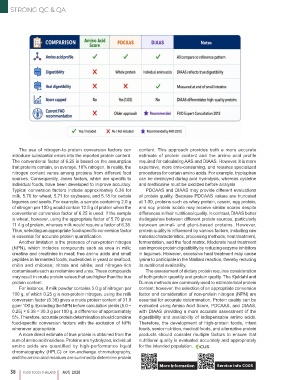
             Typical conversion factors include approximately 6.38 for   PDCAAS and DIAAS may provide different evaluations
             milk, 5.70 for wheat, 5.71 for soybeans, and 5.18 for certain   of protein quality. Because PDCAAS values are truncated
             legumes and seeds. For example, a sample containing 2.0 g   at 1.00, proteins such as whey protein, casein, egg protein,
             of nitrogen per 100 g would contain 12.5 g of protein when the   and soy protein isolate may receive similar scores despite
             conventional conversion factor of 6.25 is used. If the sample   differences in their nutritional quality. In contrast, DIAAS better
             is wheat, however, using the appropriate factor of 5.70 gives   distinguishes between different protein sources, particularly
             11.4 g of protein, whereas milk would require a factor of 6.38.   between animal- and plant-based proteins. However,
             Thus, selecting an appropriate food-specific conversion factor   protein quality is influenced by various factors, including raw
             is essential for accurate protein quantification.    material characteristics, processing methods, heat treatment,
                Another limitation is the presence of non-protein nitrogen   fermentation, and the food matrix. Moderate heat treatment
             (NPN), which includes compounds such as urea in milk;   can improve protein digestibility by reducing enzyme inhibitors
             creatine and creatinine in meat; free amino acids and small   in legumes. However, excessive heat treatment may cause
             peptides in fermented foods; nucleotides in yeast or seafood;   lysine to participate in the Maillard reaction, thereby reducing
             chitin and chitosan; nitrate and nitrite; and nitrogen-rich   its nutritional availability.
             contaminants such as melamine and urea. These compounds   The assessment of dietary protein requires consideration
             may result in crude protein values that are higher than the true   of both protein quantity and protein quality. The Kjeldahl and
             protein content.                                     Dumas methods are commonly used to estimate total protein
                For instance, if milk powder contains 5.0 g of nitrogen per   content; however, the selection of an appropriate conversion
             100 g, of which 0.25 g is non-protein nitrogen, using the milk   factor and consideration of non-protein nitrogen (NPN) are
             conversion factor (6.38) gives a crude protein content of 31.9   essential for accurate determination. Protein quality can be
             g per 100 g. Excluding the NPN before calculation yields (5.0 −   evaluated using Amino Acid Score, PDCAAS, and DIAAS,
             0.25) × 6.38 = 30.3 g per 100 g, a difference of approximately   with DIAAS providing a more accurate assessment of the
             5%. Therefore, accurate protein determination should combine   digestibility and availability of indispensable amino acids.
             food-specific conversion factors with the exclusion of NPN   Therefore, the development of high-protein foods, infant
             whenever appropriate.                                foods, senior nutrition, medical foods, and alternative protein
                A more direct estimate of true protein is obtained from the   products should consider multiple factors to ensure that
             sum of amino acid residues. Proteins are hydrolyzed, individual   nutritional quality is evaluated accurately and appropriately
             amino  acids  are  quantified  by  high-performance  liquid   for the intended population.
             chromatography (HPLC) or ion-exchange chromatography,
             and the amino acid residues are summed to determine protein
                                                                          More Information        Service Info C005
            38   FOOD FOCUS THAILAND  AUG  2026


                                                                                                                     27/7/2569 BE   10:25
         34-38_Strong QC&QA_Atikom.indd   38
         34-38_Strong QC&QA_Atikom.indd   38                                                                         27/7/2569 BE   10:25

